Missions / Clients
Case Study – GYEONGGISat-1: Enabling Climate Intelligence From Space
Back to our blog
A Mission Powered by Nara Space Technology, With Anywaves’ X-Band Payload Telemetry Antenna Onboard
Climate change is accelerating, and public authorities worldwide increasingly rely on satellite-based Earth observation to shape resilient, data-driven environmental policy. In this context, the Gyeonggi Climate Satellite program marks an important milestone. It is the first time a Korean local government has initiated, funded, and deployed its own satellites specifically to support climate strategy, environmental monitoring, and fast-response disaster assessment.
Designed and manufactured by Nara Space Technology, GYEONGGISat-1 is the first of a three-satellite climate constellation. It demonstrates how agile space companies can deliver high performance Earth-observation capabilities on compact platforms, using proven technologies and mature industrial partnerships. Among these subsystems, Anywaves’ X-band Payload Telemetry Antenna was selected to ensure high-rate downlink of multispectral imagery, a critical prerequisite for transforming collected data into actionable climate knowledge.
This mission also reflects the continuity of the long-term partnership between Anywaves and Nara Space. Over several years, our teams have collaborated across multiple programs, each time reinforcing mutual trust. We are proud to keep contributing to Nara Space’s growth and to support their expanding fleet of innovative satellites.
This case study explores the mission objectives, its strategic context, and the role of Anywaves’ antenna in supporting GYEONGGISat-1.
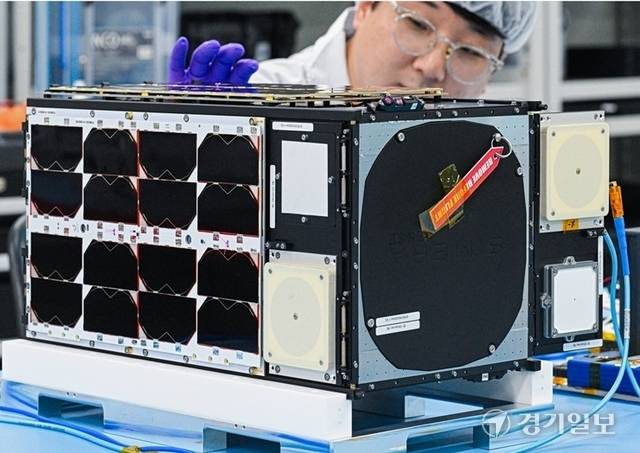
GYEONGGISat-1. Source: Nara Space
Mission Overview
On 29 November 2025 at 03:44 KST, a SpaceX Falcon 9 lifted off from Vandenberg Space Force Base carrying a small spacecraft with an ambitious mandate: GYEONGGISat-1, South Korea’s first climate-monitoring satellite commissioned by a local government. Designed and realized by Nara Space Technology, the satellite marks a decisive step in Gyeonggi Province’s strategy to develop scientifically grounded climate policy, integrate space-derived data into environmental management, and foster a regional climate-tech industry.

On the 29th around 3:40 AM, a U.S. SpaceX Falcon 9 rocket carrying the Gyeonggi Climate Satellite No. 1 rises into the sky. /Gyeonggi Province YouTube
Approximately 56 minutes after liftoff, the CubeSat was released into its nominal orbit at roughly 500 km altitude. Shortly afterward, stable two-way communication was established with Nara Space’s ground center in Seoul, confirming that all core subsystems had reached nominal behavior, including the X-band downlink system.
Despite its compact 20 x 20 x 40 cm form factor and a mass of 25 kg, GYEONGGISat-1 carries a high performance multispectral optical imager designed to acquire 14 x 40 km scenes over the province. The satellite will monitor land-use change, vegetation dynamics, wildfire or flood damage, and broader climate-relevant indicators for a planned operational lifetime of three years.
It is the first unit in a larger program: two additional satellites, GYEONGGISat-2A and -2B, are scheduled for launch next year, equipped with methane and CO2 sensors.
For Anywaves, this mission represents another validation of our antennas onboard operational Earth-observation missions, and another chapter in our long-standing partnership with Nara Space.
Strategic Context – A Local Government Steps Into Space
Climate Policy Driven by Objective Data
The Gyeonggi Provincial Government initiated the satellite program to obtain direct, repeatable Earth-observation data supporting:
- Monitoring of greenhouse gas sources (methane, CO₂)
- Disaster response: rapid assessment of floods, wildfires, and landslides
- Urban change mapping to guide sustainable development
- Agricultural monitoring, including rice-paddy analysis and crop-yield forecasting
- Land-use compliance and detection of illegal deforestation or construction
This initiative reflects a growing trend in the New Space paradigm, where public entities leverage agile private-sector platforms to obtain operational space services at reduced cost and timeline.
An Effective Public-Private Model Led by Nara Space
The mission was realized through a collaborative framework in which:
- Gyeonggi Province defined the policy objectives
- Nara Space Technology led design, manufacturing, integration, testing, operations, and mission data processing
- Industrial partners, including Anywaves, provided key flight-proven components
By adopting technologies with existing heritage, the program achieved an effective balance between risk reduction, cost control, and development speed.
For Anywaves, the project demonstrates once again the relevance of compact, high-performance antennas optimized for microsatellites.
Why This Mission Matters
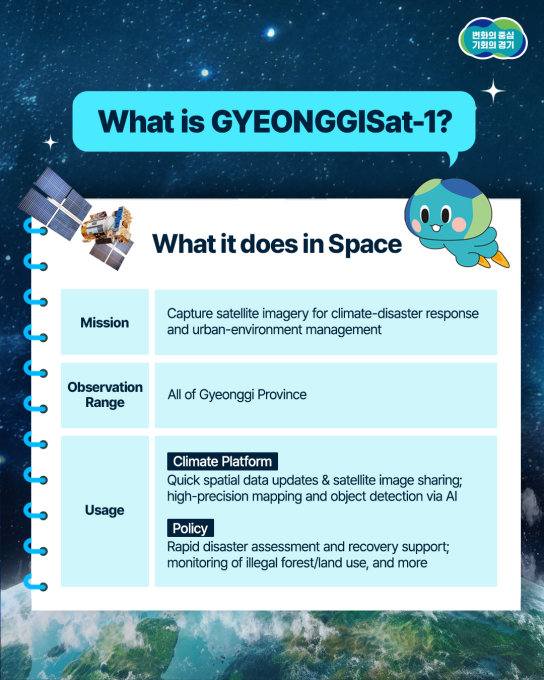
Source: https://www.gyeonggido-korea.com/
Scientific and Policy Impact
The satellite provides high value data for:
- climate resilience strategies,
- environmental compliance monitoring,
- land management and agricultural planning,
- natural disaster response,
- regional climate-tech ecosystem development.
Strengthening the Korean New Space Sector
Nara Space’s execution, from design to data exploitation, demonstrates a strong industrial capability emerging in South Korea. GYEONGGISat-1 adds to its accumulated space heritage and supports its roadmap toward a larger constellation of 84 microsatellites.
Technical Profile of GYEONGGISat-1
Spacecraft Characteristics
| Specification | Value |
|---|---|
| Platform | Enhanced 6U CubeSat |
| Dimensions | 20 x 20 x 40 cm |
| Mass | ~25 kg |
| Orbit | ~500 km circular LEO |
| Mission Lifetime | 3 years |
| Primary Payload | Multispectral optical camera |
| Swath | 14 x 40 km |
| Builder and Operator | Nara Space Technology |
The platform is equipped with a high-resolution optical payload and a high-speed data processor. Solar panels power the satellite, and autonomous deorbiting at end-of-life ensures compliance with responsible space operations.
Mission Data Downlink Requirements
The satellite’s imaging system produces large volumes of multispectral data. To transfer these datasets efficiently to the ground, Nara Space selected a high-rate X-Band downlink subsystem – a configuration increasingly adopted across modern microsatellite missions.
This is where Anywaves’ contribution comes in.
Anywaves’ Contribution – X-Band Payload Telemetry Antenna
Role on GYEONGGISat-1
GYEONGGISat-1 integrates Anywaves’ X-Band Payload Telemetry Antenna, a compact and robust radiator designed specifically for small platforms requiring high-rate Earth-observation downlinks.
Its function is central in the mission architecture: enabling rapid transmission of large multispectral image datasets from orbit to ground without compromising link stability or data integrity.
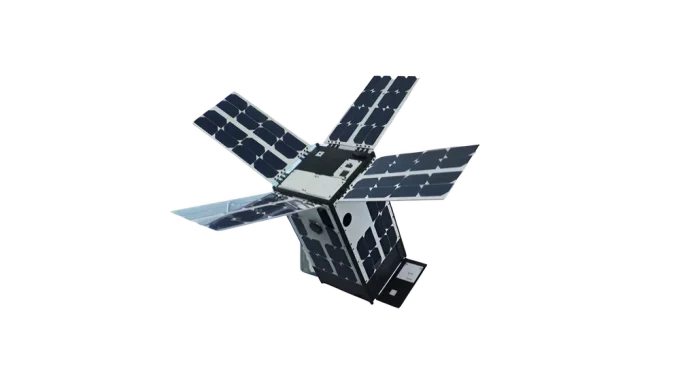
GYEONGGISat-1. Credits: Nara Space
Key Features
- Frequency Band: 8.025 – 8.400 GHz
- Polarization: Right- or Left-Hand Circular Polarization
- Gain: ~11.5 dBi at boresight
- Envelope: 72.6 × 72.6 × 11 mm (under 1U)
- Mass: 59 g with connector
- TRL 9 — fully space-qualified and flight-proven
Heritage and Reliability
The antenna used on GYEONGGISat-1 is the our old X-band Data Downlink antenna model. Developed in partnership with CNES, this antenna has accumulated substantial flight heritage since 2019, supporting high-data-rate missions and contributing to the collection of thousands of Earth images for scientific and commercial applications. Examples include CNES EyeSat, U-Space Pandore and SOAP, ESA PROBA-V Companion CubeSat, POLSA EagleEye, and Nara Space Observer-1A and Observer-1B.
This wide and diverse flight heritage demonstrates the antenna’s reliability for high data rate Earth-observation missions.
This mission continues a long-term collaboration between Anywaves and Nara Space. Each new program reinforces our mutual confidence, and we are pleased to see our antenna technology supporting the evolution of their satellite fleet.
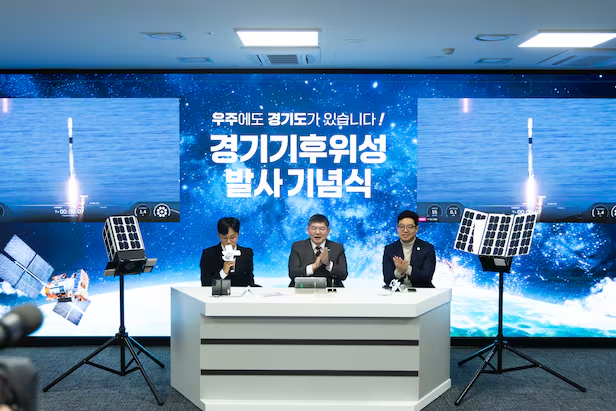
On the morning of the 29th, a commemoration ceremony for the Gyeonggi Climate Satellite launch is held at the Gyeonggi Province Library Media Studio. From left in photo: MC Jang Yeon-jin, Cha Seong-su Gyeonggi Province Climate, Environment and Energy Director, and Park Jae-pil CEO of Nara Space. /Gyeonggi Province
Mission Operations & Early Results
Deployment and First Contact
After separation at T+56 minutes:
- The satellite autonomously stabilized
- X-Band and UHF/S-Band communications were checked
- Nara Space’s ground segment obtained clear telemetry frames, validating transmitter/antenna alignment and link budget predictions
The early downlink performance confirmed the nominal behavior of the X-Band subsystem.
A Building Block for a Full Climate Constellation
GYEONGGISat-1 inaugurates a broader constellation that will:
- Integrate optical imagery (GYEONGGISat-1)
- Combine methane and CO₂ sensing (GYEONGGISat-2A, -2B)
- Feed climate-relevant analytics into the Gyeonggi Climate Platform
- Support a regional ecosystem of climate-tech startups and research institutes
This mission is both operational and symbolic: the first time a Korean local government has fielded its own satellites.
Conclusion
GYEONGGISat-1 illustrates the potential of compact, high performance microsatellites to deliver strategic climate intelligence. The program represents a decisive step for Gyeonggi Province and an important demonstration for the Korean New Space sector.
For Anywaves, contributing our X-band antenna to this mission is both a technical accomplishment and a continuation of a partnership we value greatly. Over the years, Nara Space has consistently demonstrated ambition, precision, and engineering excellence. We are proud to support their journey, to contribute to their missions with our antenna expertise, and to play our part in enabling reliable communication between orbit and Earth.
As the constellation expands, we look forward to continuing this collaboration and supporting future programs with the same rigor and commitment.


Contact
us
If you have any question, we would be happy to help you out.
Close
Search through our content

Manage Cookie Consent
Functional Always active
The technical storage or access is strictly necessary for the legitimate purpose of enabling the use of a specific service explicitly requested by the subscriber or user, or for the sole purpose of carrying out the transmission of a communication over an electronic communications network.
Preferences
The technical storage or access is necessary for the legitimate purpose of storing preferences that are not requested by the subscriber or user.
Statistics
The technical storage or access that is used exclusively for statistical purposes.
The technical storage or access that is used exclusively for anonymous statistical purposes. Without a subpoena, voluntary compliance on the part of your Internet Service Provider, or additional records from a third party, information stored or retrieved for this purpose alone cannot usually be used to identify you.
Marketing
The technical storage or access is required to create user profiles to send advertising, or to track the user on a website or across several websites for similar marketing purposes.
Manage Cookie Consent
Functional Always active
The technical storage or access is strictly necessary for the legitimate purpose of enabling the use of a specific service explicitly requested by the subscriber or user, or for the sole purpose of carrying out the transmission of a communication over an electronic communications network.
Preferences
The technical storage or access is necessary for the legitimate purpose of storing preferences that are not requested by the subscriber or user.
Statistics
The technical storage or access that is used exclusively for statistical purposes.
The technical storage or access that is used exclusively for anonymous statistical purposes. Without a subpoena, voluntary compliance on the part of your Internet Service Provider, or additional records from a third party, information stored or retrieved for this purpose alone cannot usually be used to identify you.
Marketing
The technical storage or access is required to create user profiles to send advertising, or to track the user on a website or across several websites for similar marketing purposes.