Innovation at Anywaves
Space missions are getting more ambitious, and the hardware that enables them must evolve accordingly. At Anywaves, innovation is driven by a clear objective: delivering space‑qualified RF electronics and antennas technologies that combine performance, reliability, and long‑term operability.
We design and manufacture space antennas, RF equipment, and space electronics in-house. Across these product lines, our approach is consistent: we take technologies proven in adjacent fields, adapt them to the constraints of space, and retain full control over design, manufacturing, and qualification.
The result is hardware that advances where it matters most — frequency capability, integration density, radiation tolerance, and form factor — backed by validation on demanding programmes and real‑world mission environments that generate flight heritage.
Our Innovation DNA
A few principles shape how we approach innovation. They are simple enough to state, but they genuinely influence the decisions we make day to day.
We take calculated risks.
We borrow from other industries.
We test early and often.
We integrate to improve.
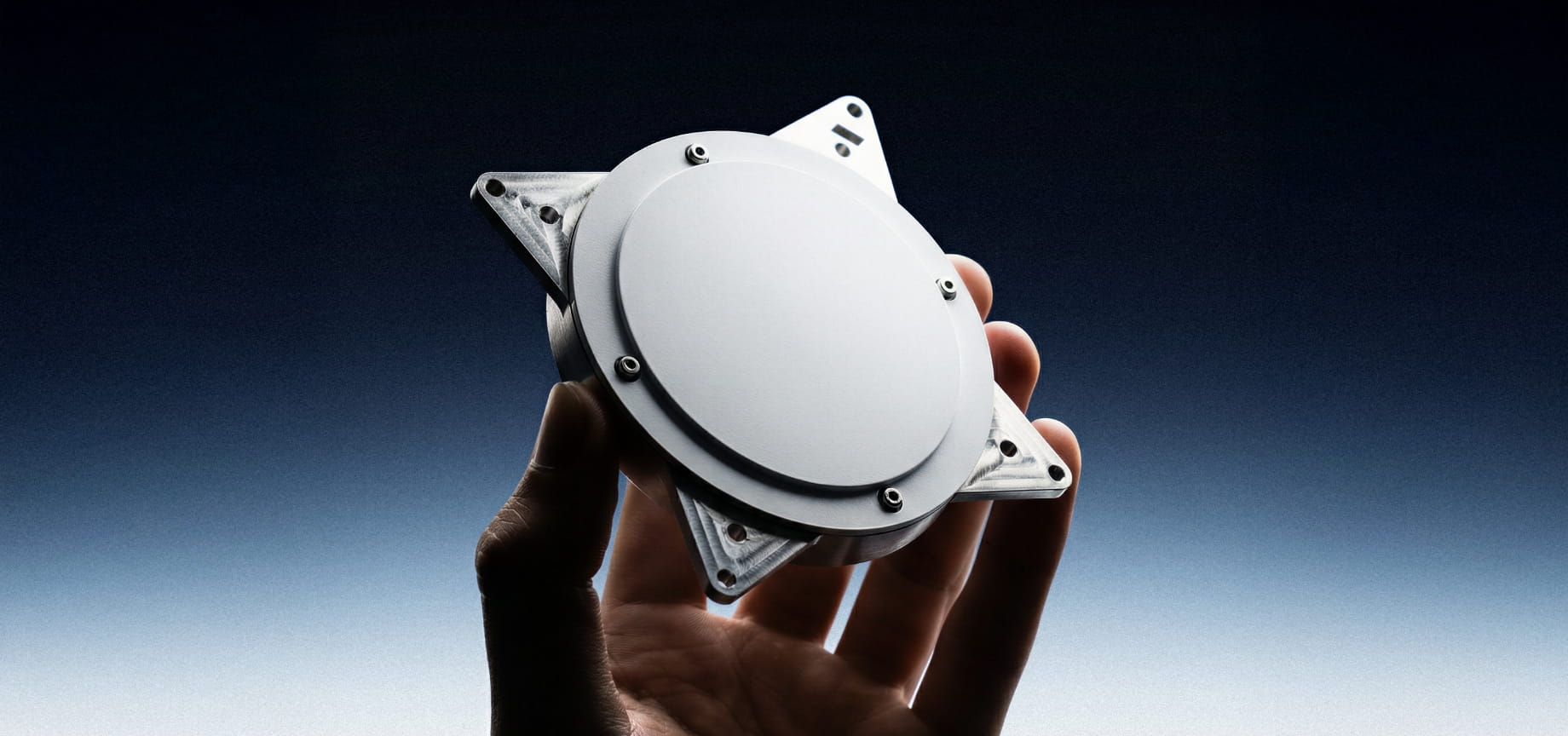
Some of our most meaningful progress comes from technologies already proven in consumer electronics, industrial processing, or advanced computing. We focus on doing the work required to adapt and qualify them for space. The space industry does not have a monopoly on good ideas, and we actively look outside it.
Some of our most meaningful progress comes from technologies already proven in consumer electronics, industrial processing, or advanced computing. We focus on doing the work required to adapt and qualify them for space. The space industry does not have a monopoly on good ideas, and we actively look outside it.
Simulation is essential and we use it throughout our work. But it cannot replace physical test results on representative hardware. Our in-house fabrication capability allows us to put hardware on the bench early enough for test results to directly shape the design.
The biggest gains in performance, size, and cost come from tighter integration: a more compact RF chain, MMIC packaged in-house, or antennas designed for a specific platform rather than a generic specification. Integration is where most of the value is created.




Our Latest Innovations
Reflectarray Antenna
Achieving high gain on a small satellite traditionally required a large parabolic dish, bringing significant volume, mass, and deployment risk that most small satellite programmes cannot absorb. The Reflectarray changes that equation. By replacing the curved reflector with flat, foldable panels that locally control the phase of reflected RF waves, it delivers parabolic-class performance in a form factor that actually fits the platform.
Covering X- to Ka-band with scalability toward Q/V bands, the Reflectarray is now flight-proven as the first commercial Reflectarray ever deployed in orbit, in Ka-band. For missions requiring high-data-rate link without the constraints of traditional high-gain antennas, the Reflectarray offers a flight validated solution.
VILSA Software Defined Radio
The VILSA Software Defined Radio introduces a fully synchronous, multi channel RF architecture for space applications, where timing control and system level synchronisation are critical. Built on a Zynq® UltraScale+ SoC, it supports up to six receive and four transmit channels driven by a common clocking scheme that can be externally disciplined to a spacecraft or payload reference. Wideband direct sampling supports natively high frequency operation, while the large channel count enables advanced multi signal and multi antenna payloads. Additional, user accessible local oscillator outputs allow the architecture to extend beyond the unit itself into external RF front ends (e.g. up- and down-converters). Combined with large onboard memory and in flight reconfigurability, VILSA supports time synchronised RF payloads that can evolve over the mission lifetime.
Quadrifilar Helix Antenna
Maintaining consistent RF coverage between a moving satellite and a ground station, is challenging when link geometry evolves continuously. Anywaves’ Quadrifilar Helix Antennas are designed specifically to address this, using an isoflux radiation pattern that delivers stable signal quality without coverage gaps.
Available in fixed and deployable versions, the deployable variant offers a stowed volume below 1.5U and mast-based deployment. Covering frequency ranges from UHF to S-band, these antennas are well suited to data transmission, LEO-PNT, and IoT applications, where predictable coverage and robustness are essential. Each antenna is tailored to its mission and delivered with acceptance testing.
Related Expertise

Contact us
Discuss your mission, technical constraints or upcoming developments directly with our engineering team.
Innovation in space hardware: key questions
-
What makes innovation in space hardware different from other industries?
Unlike most industries, space hardware cannot be repaired or upgraded once deployed. Innovation must therefore balance performance gains with absolute reliability. Every new approach — whether architectural, material or component-level — must be validated under representative environmental conditions before it can be considered viable.
-
How do you manage the risks associated with new technologies?
We combine simulation, rapid prototyping and early testing to validate concepts progressively. Critical elements are identified early and verified through dedicated test campaigns, including radiation, thermal and mechanical validation. This allows us to introduce innovation without compromising mission reliability.
-
Do your innovations rely on flight heritage?
Yes, but not exclusively. We build on existing flight-proven technologies where relevant, while introducing targeted innovations in specific parts of the system. This approach allows us to improve performance without exposing the entire architecture to unnecessary risk.
-
Can your technologies be adapted to different missions?
Our designs are modular and scalable by construction. Whether adapting to a new frequency band, platform constraint, or mission profile, we prioritise architectures that can evolve without requiring a complete redesign.
-
How does in-house development impact innovation?
Keeping design, manufacturing and testing in-house shortens feedback loops significantly. It allows test results to directly influence design iterations, enables faster validation cycles, and ensures tighter control over performance and quality.
-
What role does radiation testing play in innovation?
Radiation testing is a critical enabler. It allows us to qualify components and architectures that are not originally designed for space, expanding the range of usable technologies while maintaining confidence in long-term performance.
Innovation in space antennas and RF electronics
Innovation in space hardware requires a balance between performance and reliability. At Anywaves, we develop space antennas, RF electronics and software-defined radio systems by combining advanced engineering with in-house manufacturing, testing and qualification.
By adapting proven technologies to the constraints of space and validating them through real mission environments, we deliver compact, high-performance and radiation-tolerant solutions for telecommunications, Earth observation, navigation and deep space missions.
