Space Antennas: The Brain Teaser of Deployable Mechanism
Download White Paper
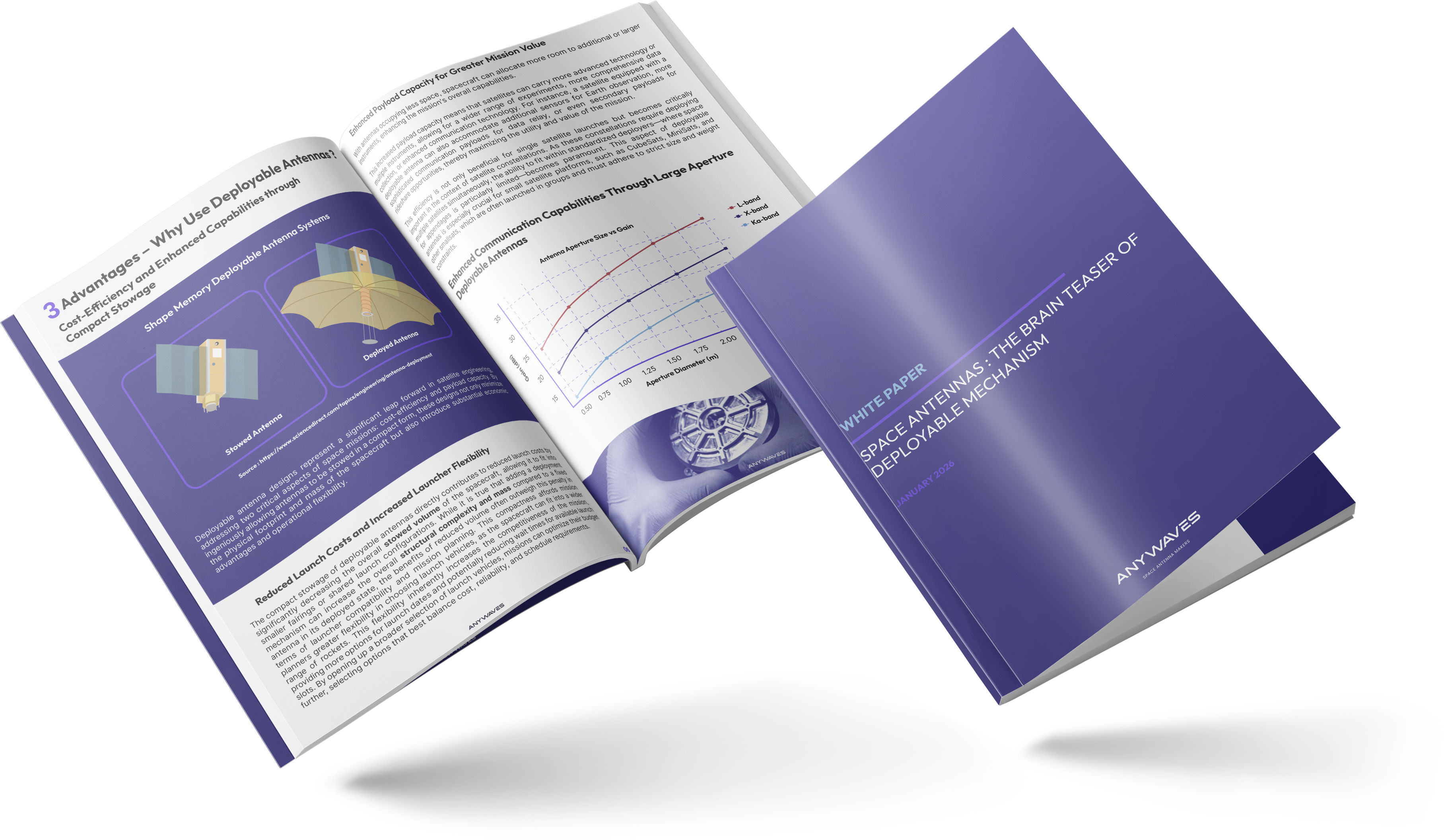
A Practical White Paper on Deployable Antenna Engineering
Designing a deployable antenna is never just a mechanical exercise. It is a tightly coupled RF, thermal, and structural challenge where millimeter-scale deviations can translate into lost link margin, degraded coverage, or unexpected in-orbit behavior – especially at high frequencies. As spacecraft platforms become smaller and mission demands increase, deployable antennas are often the only viable way to reconcile launch constraints with in-orbit performance.
This white paper explores why deployable antennas have become a critical enabler for modern space missions, and why they remain among the most demanding subsystems to engineer. From deployment kinematics and multi-physics modeling to thermal distortion control, RF tolerance management, and qualification strategy, it provides a structured, engineering-level perspective on what it really takes to design, validate, and integrate a reliable deployable antenna into a space system.
What You’ll Learn Inside
This white paper provides an engineering-level breakdown of deployable antenna design, with a focus on the real constraints and trade-offs faced during spacecraft development and qualification:
-
How launcher constraints, stowage volume, frequency band, and link budget requirements converge to justify deployment—and when a fixed antenna is the safer option.
-
Why deployment accuracy, surface stability, and repeatability directly impact gain, beam shape, and efficiency, particularly at high frequencies.
-
Key deployment architectures, their inherent risks, and how kinematics, friction, and clearances influence in-orbit behavior.
-
How thermal gradients and cycling distort large deployed structures, and what material and design strategies help preserve RF geometry.
-
How to approach deployable antennas as a single-point-of-failure risk, including margining philosophy, redundancy logic, and qualification testing strategy.
-
Practical considerations often discovered late in the program: power and command interfaces, EMC, mechanical shocks during deployment, and interactions with AOCS.
