Onboard ESA’s Hera mission, the Juventas CubeSat carries JuRa, the smallest low-frequency radar ever flown in space and the first instrument to probe the inside of an asteroid. Its core electronics were designed and delivered by EmTroniX, now part of Anywaves.
This article looks at Juventas, the JuRa radar it carries, and the role Anywaves’ radar payload electronics play in giving scientists their first direct look inside an asteroid.
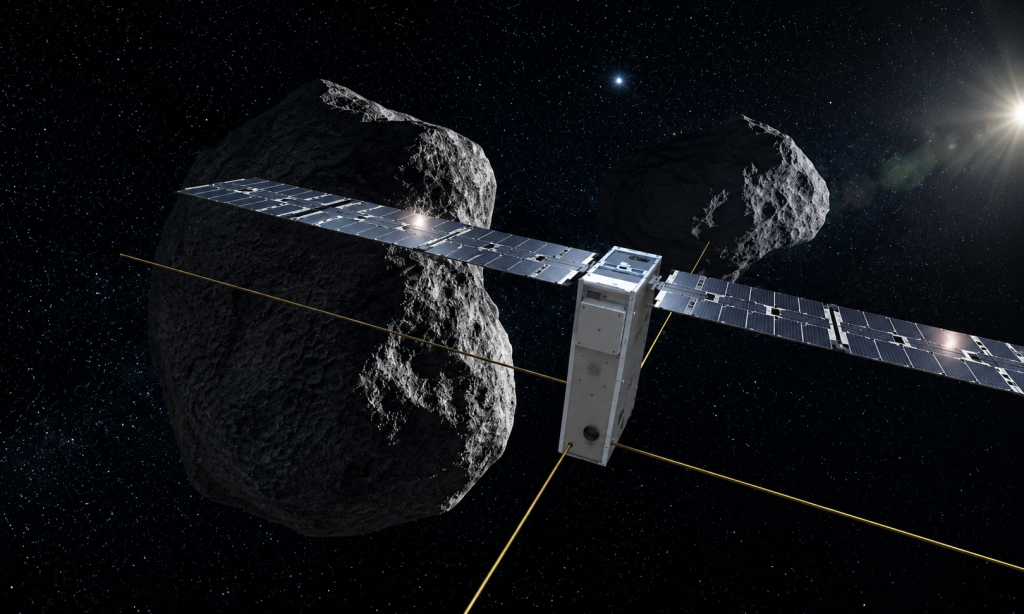
Hera-Juventas: Scanning the Heart of an Asteroid
For a planetary defense mission, the question that matters most is a simple one: what is an asteroid actually made of? Is it a solid rock, or a loose pile of rubble held together by little more than its own weak gravity? The answer changes everything about how you would deflect it. JuRa exists to answer exactly that question, and Anywaves is proud to have contributed the radar electronics that make it possible.
JuRa flies as the primary instrument on Juventas, one of two CubeSats carried by ESA’s Hera spacecraft to the Didymos binary asteroid system. Hera is Europe’s contribution to the international Asteroid Impact and Deflection Assessment (AIDA) collaboration with NASA, returning to Dimorphos four years after it was struck by NASA’s DART mission in September 2022 to measure the effect of that impact in detail.
A First in Planetary Science
No spacecraft has ever measured the internal structure of an asteroid directly. Every past mission has had to infer composition from the outside: surface imaging, spectroscopy, density estimates from mass and volume. JuRa changes that by sending radar signals into Dimorphos and reading what comes back, turning the asteroid’s interior from a guess into a measurement.
Once Juventas reaches its science orbit, it will use JuRa to map the entirety of Dimorphos at a resolution of a few meters, and the region around the DART impact site at a resolution of around 10 centimeters. Combined with an independent mass estimate, this data will allow scientists to calculate, for the first time, how efficiently DART’s kinetic impact transferred momentum to the asteroid, a number that future planetary defense missions will depend on.
From Hera to RAMSES: A Growing Specialty
JuRa is the first generation of a technology line that EmTroniX, now Anywaves, continues to develop. A second-generation low-frequency radar system is already in progress for ESA’s planned RAMSES mission to asteroid Apophis, which will rendezvous with Apophis ahead of its close flyby of Earth in 2029. Hera-Juventas is where this radar expertise was proven in flight.
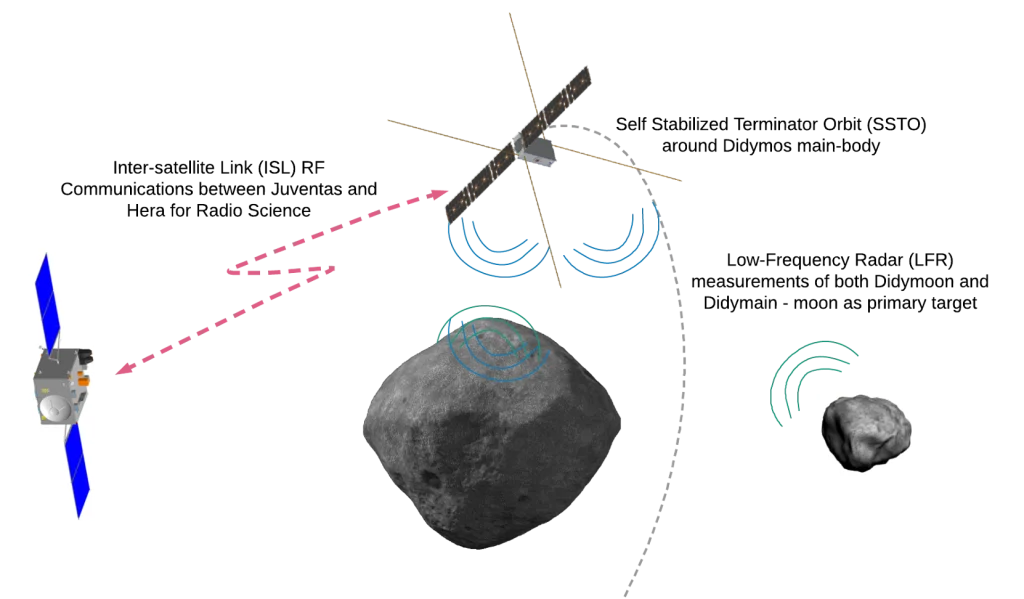
The Juventas CubeSat
Juventas is a 6-unit CubeSat, roughly the size of a shoebox, built around a platform shared with its sibling CubeSat Milani. Despite its small size, Juventas is built for deep space rather than the low Earth orbit most CubeSats are designed for, and it is tasked with one of the most delicate maneuvers ever attempted by a spacecraft of its class: landing on an asteroid.
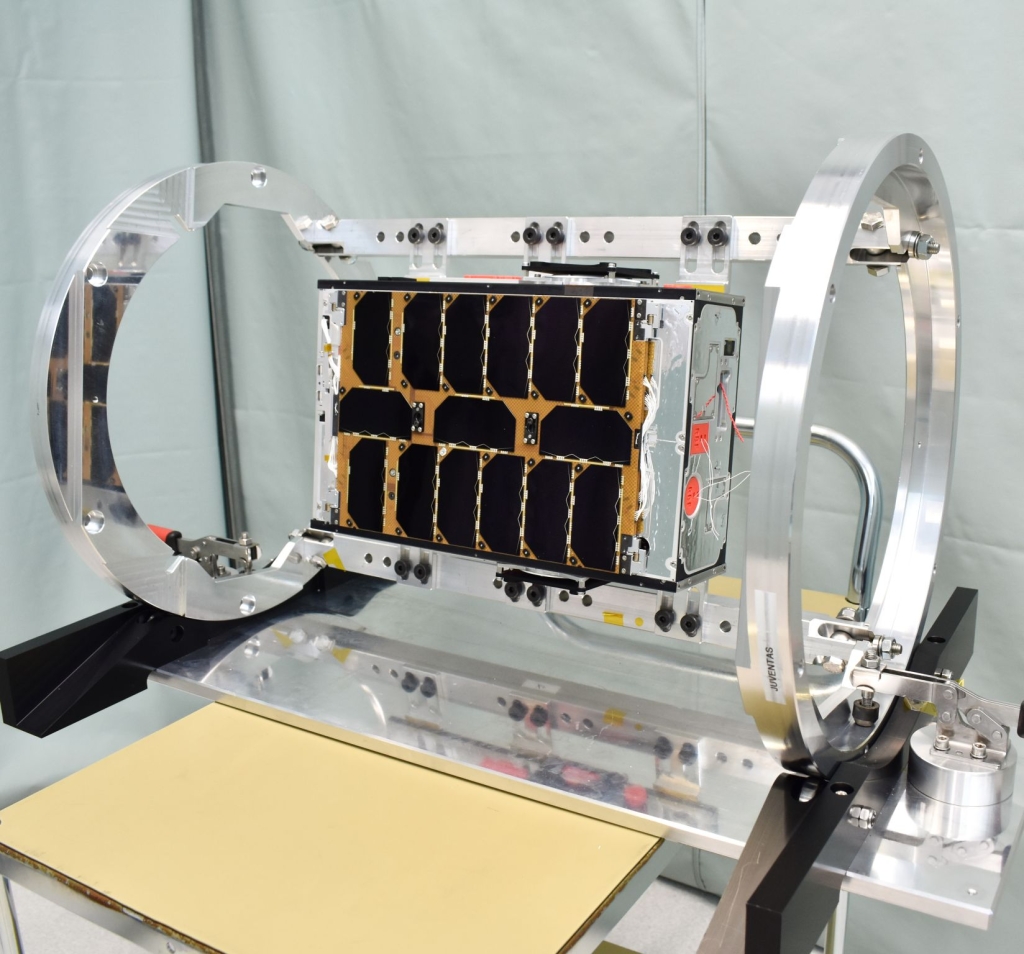
Key Characteristics
- Compact platform: measuring just 37 x 23 x 10 cm, built around a 6-unit CubeSat structure and developed for ESA by Luxembourg’s GomSpace.
- Deep-space CubeSat: one of the first CubeSats designed to operate far beyond Earth orbit, with the precise navigation and thermal control that this demands.
- Primary instrument – JuRa radar: a low-frequency radar operating at 50–70 MHz, transmitting through four 1.5-meter deployable antennas longer than the spacecraft itself.
- Secondary payload – GRASS gravimeter: developed by the Royal Observatory of Belgium and Spain’s EMXYS, to directly measure Dimorphos’ gravity field once Juventas lands.
- Inter-satellite link: communicates with the Hera mothership in S-band, relaying both housekeeping data and JuRa’s science data back to Earth.
A Mission of Extremes
Juventas will operate in a unique ‘self-stabilised terminator orbit’ around Didymos, balancing the asteroid’s faint gravity against the gentle push of sunlight, since gravity alone is far too weak to hold a stable orbit. At that altitude, Juventas moves at only centimeters per second relative to Dimorphos, slow enough that JuRa can send the same coded radar signal multiple times and combine the echoes to boost its signal-to-noise ratio.
Once its radar survey is complete, Juventas will attempt to land on Dimorphos to operate GRASS at the surface, a maneuver that, if successful, will make it the smallest spacecraft ever to land on a celestial body.
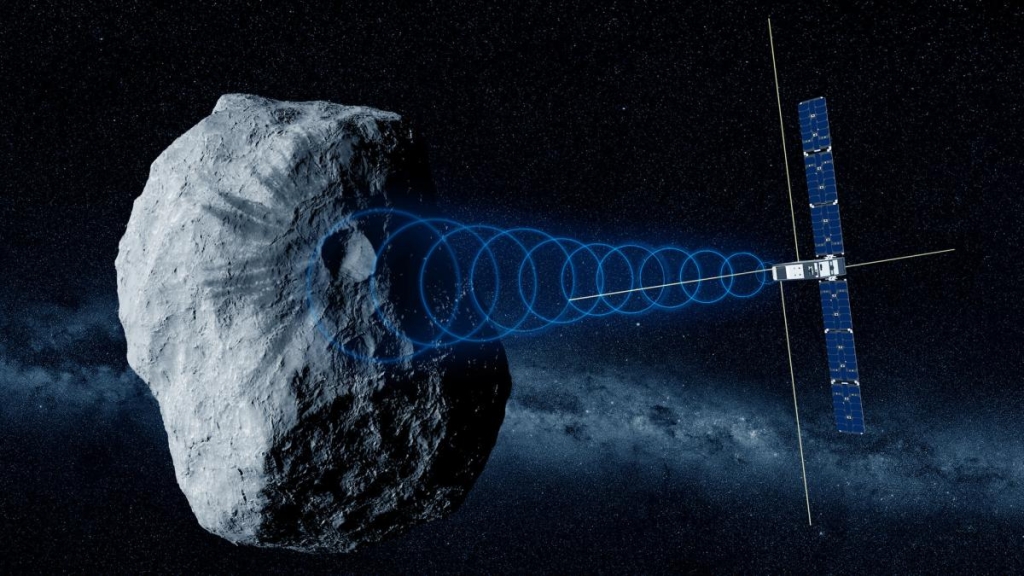
Anywaves’ Radar Payload Electronics Onboard
A radar instrument is only as good as the electronics that drive it. On Juventas, that role belongs to the core electronics of JuRa (Juventas Radar), designed and delivered by EmTroniX, now part of Anywaves.
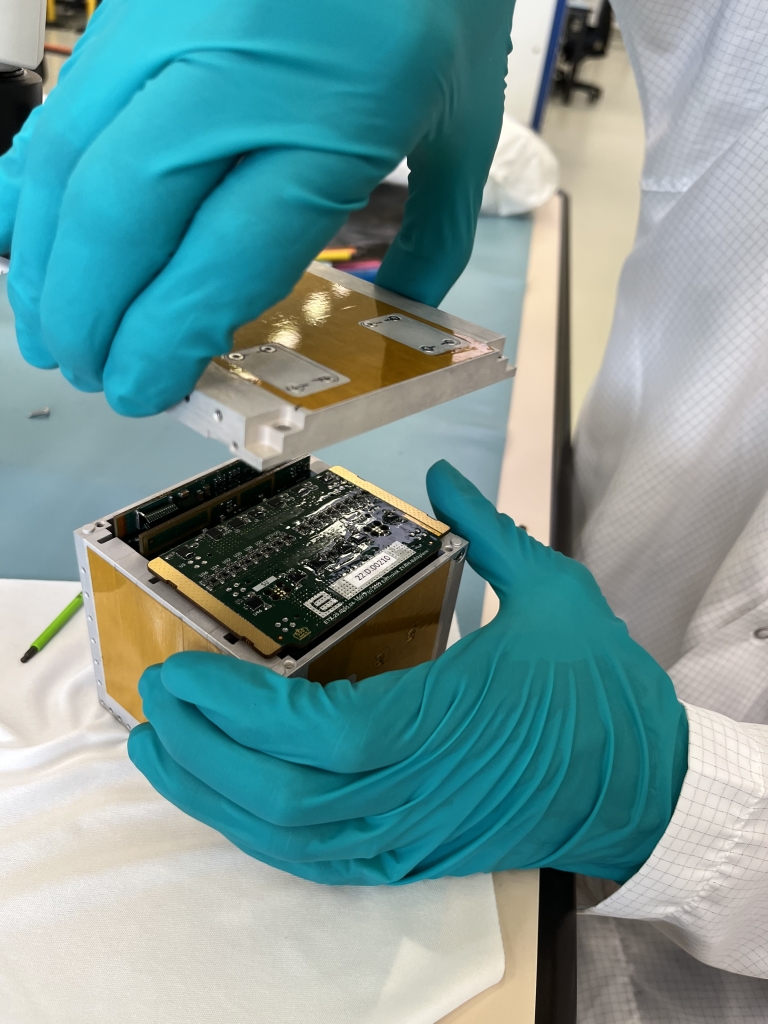
The Smallest Radar Ever Flown in Space
EmTroniX’s electronics generate the radar’s transmit signal, acquire the returning echoes, and process them, all within a footprint that fits inside a single 10 cm cubic unit. It is a remarkable feat of miniaturisation: a complete radar transmit-receive chain, built to operate unattended for years in deep space, compressed into a fraction of the volume of a typical Earth-orbit radar payload.
- Complete payload electronics: signal generation, acquisition, and processing subsystems, integrating high-speed ADC/DAC components with FPGA-based digital processing.
- Deep subsurface reach: engineered to penetrate up to 100 meters into Dimorphos, mapping internal structure, density variations, and composition in 3D.
- Built for deep-space radiation: designed to operate reliably through the radiation environment of interplanetary space, with no opportunity for in-flight repair.
- A collaborative European instrument: developed alongside IPAG and TU Dresden (radar design), FSatCom (FPGA signal processing), and Astronika (deployable antennas), with CNES supporting the programme.
Precision Engineering for a Single Shot
Generating a clean, precisely timed radar pulse and capturing a faint returning echo, all while drawing minimal power on a CubeSat with no margin for a second attempt, asked a lot of EmTroniX’s design team. Low-noise signal generation, careful timing, and robust digital processing all had to come together in an instrument that would only get one mission to prove itself.
It is this electronics package that turns JuRa from a radar concept into usable science: every echo it captures becomes another data point in the first map ever made of an asteroid’s interior.
Mission Status and What’s Ahead
Current Status
- Hera launched on 7 October 2024 from Cape Canaveral, with Juventas and Milani onboard.
- Following a Mars gravity-assist flyby in March 2025 and a major deep-space maneuver in early 2026, Hera is now on track to reach Didymos in November 2026, a month earlier than originally planned.
- Precision braking maneuvers are due to begin in October 2026 to bring Hera into rendezvous with the asteroid system.
- Once Hera arrives, Juventas will be deployed for its radar survey phase, followed by an attempted landing on Dimorphos.
- JuRa will then deliver the first direct measurements of an asteroid’s internal structure ever taken.
Building on JuRa: RAMSES and Beyond
Hera-Juventas is the proving ground for a radar technology line that continues to grow. Anywaves, through its EmTroniX heritage, is now developing a second-generation low-frequency radar for ESA’s planned RAMSES mission to Apophis, launching in 2028 to study how Earth’s tidal forces affect the asteroid during its exceptionally close 2029 flyby.
Together, Hera and RAMSES position Anywaves as a continuing contributor to Europe’s planetary defense capability, this time from the inside of the asteroid out.
Conclusion
JuRa shows what becomes possible when a radar instrument is built specifically for the constraints of deep space: a complete transmit-receive chain, compact enough for a shoebox-sized CubeSat, reliable enough to operate years from Earth with no second chance.
For Anywaves, contributing JuRa’s radar payload electronics to the Juventas CubeSat, through our EmTroniX heritage, stands alongside our S-Band antennas on the same mission as a demonstration of the breadth of RF expertise Anywaves now brings to a single spacecraft.
As Europe’s planetary defense programme moves from Hera toward RAMSES, we look forward to continuing to support the radar and RF systems that let scientists see what no mission has seen before: the inside of an asteroid.
If you are designing a mission that needs flight-proven RF payload electronics, get in touch with our team.

