Innovation
Reflectarray Antennas for Small Satellites: From Concept to First Commercial Deployment
Back to our blog
High-gain antennas have long been a limiting factor for small satellite missions. CubeSats and NanoSats face strict constraints in volume, mass, and stowage, while mission requirements continue to push for higher data rates and more reliable links. Over the last decade, reflectarray antennas have emerged as a compelling answer to this challenge, combining the advantages of parabolic reflectors with the compactness and manufacturability of planar technologies.
At the 2025 ESA Antenna Workshop, Anywaves presented our latest work on reflectarray antenna developments for space applications. The paper, “Reflectarray Antenna Developments at Anywaves”, reports both the industrialization strategy behind a generic product and the experimental validation of a Ka-band reflectarray demonstrator, including a recent first commercial in-orbit deployment.
Reflectarray Antennas: A Short Technical History
The reflectarray concept is not new. The first formal description dates back to 1963, when Berry, Malech, and Kennedy introduced the idea of a planar surface capable of reflecting an incident wave with a controlled phase distribution. In the 1990s, advances in printed circuit technologies enabled microstrip reflectarrays, notably through the work of J. Huang and collaborators, who demonstrated variable phase control using rotated or dimension-tuned elements.
However, it was only with the rise of small satellites that reflectarrays gained renewed interest. Their intrinsic advantages (low stowage volume, flat form factor, and high achievable gain) made them particularly attractive for platforms constrained by CubeSat deployers.
A major milestone occurred in 2017, when NASA/JPL successfully validated a deployable reflectarray in orbit on the ISARA (Integrated Solar Array and Reflectarray Antenna) 3U CubeSat. That same year, a larger folded reflectarray flew on the MarCO mission, relaying data from Mars using a 6U CubeSat. These demonstrations confirmed the feasibility of reflectarrays for deep-space and LEO missions, but they remained primarily technology demonstrators rather than commercial products.
Anywaves’ Reflectarray Strategy: From R&D to Product
With the support of CNES, Anywaves has been developing a generic reflectarray antenna product tailored for NanoSat and CubeSat platforms. Rather than a mission-specific design, the objective was to define an industrialized architecture adaptable across frequencies – from X-band up to Ka-band and beyond – while ensuring long-term mechanical and RF stability.
A key innovation lies in the patent-pending metallic panel design, which combines:
- Aluminum structural panels for mechanical robustness,
- Printed cavity-backed patch elements on Kapton layers, chosen for their matched coefficient of thermal expansion (CTE) with aluminum,
- A hexagonal lattice unit cell providing close to 360° phase control in reflection.
This stack-up delivers stable RF performance over temperature and across the satellite lifetime, typically five years or more in LEO.
Ka-Band Reflectarray Demonstrator: Design and Validation
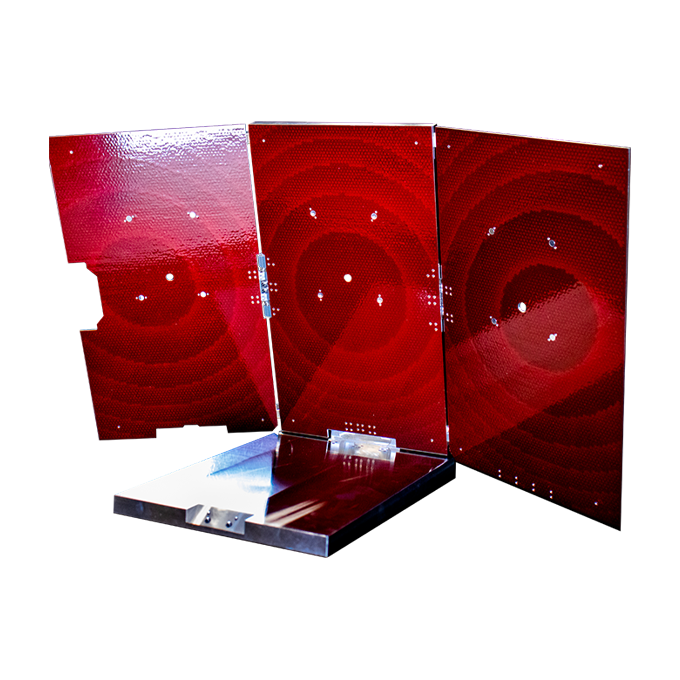
Anywaves Reflectarray Antenna
A High-Gain Antenna for NanoSats
The paper reports the development of a Ka-band reflectarray demonstrator operating from 31.8 to 34.7 GHz, targeting future high-data-rate downlink missions defined by CNES. The antenna achieves:
- Boresight directivity ≥ 40 dBi across the operational band,
- Dual-circular polarization capability,
- A realized gain above 39 dBi, accounting for losses due to materials, panel flatness, and deployment tolerances.
The antenna uses a three-panel deployable architecture, sequentially deployed in orbit via a central self-motorized hinge and lateral inter-panel hinges. This configuration approximates the curvature of an ideal reference parabola while remaining compatible with small satellite stowage constraints.
Experimental Results
Measurements performed at CNES (Toulouse) confirm:
- Stable radiation patterns before and after thermal cycling,
- Limited pointing deviation versus frequency, attributed mainly to the dispersive nature of the unit cell,
- High mechanical precision, with panel flatness on the order of 200 μm and deployment angular accuracy of ±0.1°.
These results validate both the RF and mechanical robustness of the design.
First Commercial In-Orbit Deployment
Beyond ground validation, the paper reports a successful in-orbit deployment of a similar reflectarray design, marking the first commercial deployment of a reflectarray antenna in low Earth orbit. This fast-track opportunity confirmed the maturity of the concept and its readiness for operational missions.
Building on this milestone, we are very proud to have made this reflectarray product available to institutional and commercial customers.
Conclusion
Reflectarray antennas are transitioning from experimental concepts to operational, commercial solutions for small satellite missions. By combining heritage antenna theory, modern materials, and an industrial design approach, Anywaves’ reflectarray antenna addresses one of the key challenges of NewSpace: delivering very high gain within extremely constrained volumes.
The results presented at the 2025 ESA Antenna Workshop demonstrate that reflectarrays are no longer limited to technology demonstrations: they are now ready to support future science, Earth observation, and exploration missions.
Download the full paper


Contact
us
If you have any question, we would be happy to help you out.
Close
Search through our content

Manage Cookie Consent
Functional Always active
The technical storage or access is strictly necessary for the legitimate purpose of enabling the use of a specific service explicitly requested by the subscriber or user, or for the sole purpose of carrying out the transmission of a communication over an electronic communications network.
Preferences
The technical storage or access is necessary for the legitimate purpose of storing preferences that are not requested by the subscriber or user.
Statistics
The technical storage or access that is used exclusively for statistical purposes.
The technical storage or access that is used exclusively for anonymous statistical purposes. Without a subpoena, voluntary compliance on the part of your Internet Service Provider, or additional records from a third party, information stored or retrieved for this purpose alone cannot usually be used to identify you.
Marketing
The technical storage or access is required to create user profiles to send advertising, or to track the user on a website or across several websites for similar marketing purposes.
Manage Cookie Consent
Functional Always active
The technical storage or access is strictly necessary for the legitimate purpose of enabling the use of a specific service explicitly requested by the subscriber or user, or for the sole purpose of carrying out the transmission of a communication over an electronic communications network.
Preferences
The technical storage or access is necessary for the legitimate purpose of storing preferences that are not requested by the subscriber or user.
Statistics
The technical storage or access that is used exclusively for statistical purposes.
The technical storage or access that is used exclusively for anonymous statistical purposes. Without a subpoena, voluntary compliance on the part of your Internet Service Provider, or additional records from a third party, information stored or retrieved for this purpose alone cannot usually be used to identify you.
Marketing
The technical storage or access is required to create user profiles to send advertising, or to track the user on a website or across several websites for similar marketing purposes.