Insights
RF and Mechanical-Thermal Engineering: Why Compromise Is the Core of Space Antenna Design
Back to our blog
Designing antennas for space is never the result of a single discipline working in isolation. It requires constant dialogue between engineers who approach the same problem from fundamentally different angles – and who must ultimately agree on a single, manufacturable, space-qualified solution. At the heart of this process lies one word: compromise.
At Anywaves, the relationship between RF engineering and mechanical-thermal engineering is not a formality. It is a daily, hands-on collaboration that shapes every design decision, from the very first concept phase to the final release for manufacturing. To understand how this works in practice, and why it matters so much, we continue our conversation with Gautier Mazingue, RF Team Manager, and Mathias Nicolle, Mechanical-Thermal Team Manager at Anywaves.
This is the second article in our three-part series on what makes a good space engineer today:
- Part 1 explored the skills, mindset, and professional reality of space engineers in the context of NewSpace.
- Part 2 (this article) dives into the day-to-day collaboration between RF and mechanical-thermal teams, and why compromise is at the heart of antenna design.
- Part 3 will focus on the full lifecycle constraints of space hardware, from storage on Earth to survival in orbit.
Every antenna developed at Anywaves is the product of a continuous dialogue between disciplines. But what does that complementarity actually look like from the inside?
RF & Mechanical-Thermal: a matter of Complementarity
How would you describe the complementarity between RF and mechanical-thermal disciplines?
Both: In one word: compromise.
Gautier Mazingue (RF): Antennas cannot be designed in silos. RF performance is deeply influenced by mechanical geometry, materials, and environment. You need extremely short design loops and continuous interaction.
Mathias Nicolle (Mechanical-Thermal): Every decision impacts the other discipline. That’s why we work hand in hand, from the very first concept phase.
What are the most frequent technical trade-offs?
Gautier Mazingue: Dimensions are the most obvious one: dimension versus RF performance. RF engineers want surface area to maximize gain. Mechanical engineers face strict volume envelopes, interface constraints, vibration resistance, and thermal stability requirements.
Mathias Nicolle: Weight is often less critical than volume. RF tends to want to use 100% of the available space, while mechanics needs room for interfaces, fasteners, and structural reinforcements.
Material choice is another key topic. Some materials are excellent from an RF standpoint but unsuitable mechanically or thermally — they may outgas, deform too much with temperature, or lack robustness.
A good example is reflectarray antennas. The RF concept has existed for decades, but making it compatible with mechanical and thermo-elastic constraints was the real challenge.
Gautier Mazingue: In the end, the objective is not to maximize a single parameter, but to design an antenna that truly meets the customer’s mission needs.
This is where the Project Manager plays a critical role, acting as the interface with the customer. Together, they assess whether there is flexibility on RF performance, size, or integration constraints, and where compromises can realistically be made.
There is no specification that is inherently more important than the others. When constraints become incompatible, it is ultimately up to the customer to prioritize the requirements. Our role as engineers is to provide clear technical insight on the implications of each trade-off, and to propose solutions that remain robust, realistic, and space-qualified.
Building Mutual Understanding Across Disciplines
What should RF engineers understand about mechanics and thermal, and vice versa, to work effectively?
Gautier Mazingue: RF engineers need to develop a strong sense of practical engineering common sense. That starts with leaving enough space, anticipating mechanical interfaces, and avoiding floating parts without proper supports. Many mechanical issues are recurrent, and understanding them early helps avoid unnecessary redesign loops.
It is also important to keep in mind that, depending on the topic, either RF or mechanical constraints will have the final word. On some subjects, RF performance is the driving parameter and mechanics must adapt. On others, mechanical or thermal constraints are non-negotiable, and RF solutions must be adjusted accordingly. Knowing when this balance shifts is a key part of working efficiently as a team.
This awareness allows RF engineers to design concepts that are not only performant on paper, but also realistic, robust, and compatible with the full space environment from the very beginning.
Mathias Nicolle: On our side, mechanical engineers must understand the basics of RF. For example, the difference between conductive and dielectric materials. Conductors strongly affect RF fields, while dielectrics usually offer more freedom. Respecting electromagnetic fields is essential.
The problem is that RF and mechanical fundamentals are rarely taught together. Radiation patterns or field behaviour are not part of mechanical curricula, and vice versa. That’s why internal training and on-the-job learning are so important.
You also need to understand orders of magnitude. At certain frequencies, geometry and tolerances become extremely critical, and close collaboration with RF is mandatory.
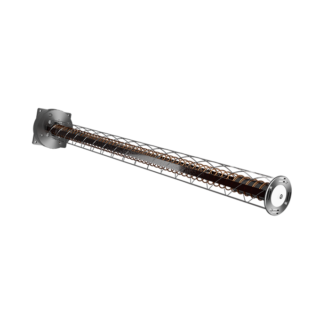
Anywaves Quadrifilar Helix Antennas, a good example of complex design.
Can you share an example of successful interdisciplinary collaboration?
Gautier Mazingue: Helical antennas are a good illustration. Their geometry is both an RF and a mechanical parameter. Changes in structure directly affect impedance matching and radiation. You cannot modify the helix without impacting both disciplines simultaneously — which is precisely why close collaboration from the earliest design stage is not optional.
What are the risks of working in silos?
Mathias Nicolle: The most common mistake is developing a concept too far within one discipline — sometimes for weeks — only to discover it’s incompatible with the other.
Gautier Mazingue: When RF and mechanical teams work together from the start, innovative solutions emerge. When they don’t, you waste time optimizing concepts that will never be compatible. Early collaboration leads not only to better solutions but often to more innovative ones. Many successful antenna designs come from this continuous back-and-forth.
When is communication most critical during a project?
Both: At the beginning, and just before manufacturing.
Mathias Nicolle: Around 80% of the design decisions are made very early in the project. If mistakes are made there, they are extremely costly later.
Gautier Mazingue: At the end, RF models become very detailed and difficult to modify. That’s why traceability, versioning, and proper PLM (Project Lifecycle Management) processes are essential before releasing hardware for manufacturing.
Conclusion: Compromise Is Not a Weakness: It Is the Skill
What this conversation makes clear is that the relationship between RF and mechanical-thermal engineering is not simply a coordination mechanism. It is a core competency in its own right. The ability to understand, challenge, and align with another discipline’s constraints – while defending one’s own – is what separates good engineers from great ones in the space industry.
Compromise is not a concession. It is the result of rigorous technical dialogue, mutual understanding, and a shared commitment to delivering hardware that must work perfectly, the first time, in one of the most hostile environments imaginable.
In Part 3 of this series, we will explore the full lifecycle of a space antenna, from storage conditions on Earth, through the launch environment, to the extreme thermal and radiation constraints of orbit, and what all of this means for design choices made long before the satellite ever leaves the ground.
Next article coming soon: From Earth to Orbit: How the Full Lifecycle of Space Hardware Shapes Every Design Decision.


Contact
us
If you have any question, we would be happy to help you out.
Close
Search through our content

Manage Cookie Consent
Functional Always active
The technical storage or access is strictly necessary for the legitimate purpose of enabling the use of a specific service explicitly requested by the subscriber or user, or for the sole purpose of carrying out the transmission of a communication over an electronic communications network.
Preferences
The technical storage or access is necessary for the legitimate purpose of storing preferences that are not requested by the subscriber or user.
Statistics
The technical storage or access that is used exclusively for statistical purposes.
The technical storage or access that is used exclusively for anonymous statistical purposes. Without a subpoena, voluntary compliance on the part of your Internet Service Provider, or additional records from a third party, information stored or retrieved for this purpose alone cannot usually be used to identify you.
Marketing
The technical storage or access is required to create user profiles to send advertising, or to track the user on a website or across several websites for similar marketing purposes.
Manage Cookie Consent
Functional Always active
The technical storage or access is strictly necessary for the legitimate purpose of enabling the use of a specific service explicitly requested by the subscriber or user, or for the sole purpose of carrying out the transmission of a communication over an electronic communications network.
Preferences
The technical storage or access is necessary for the legitimate purpose of storing preferences that are not requested by the subscriber or user.
Statistics
The technical storage or access that is used exclusively for statistical purposes.
The technical storage or access that is used exclusively for anonymous statistical purposes. Without a subpoena, voluntary compliance on the part of your Internet Service Provider, or additional records from a third party, information stored or retrieved for this purpose alone cannot usually be used to identify you.
Marketing
The technical storage or access is required to create user profiles to send advertising, or to track the user on a website or across several websites for similar marketing purposes.