EGSE Series – Article 2 of 3
In the first article of this series, we covered what Electrical Ground Support Equipment (EGSE) is and why it is a non-negotiable part of any space program. Now let’s go deeper.
If you’re building or integrating RF hardware, antennas, or communication payloads, the generic EGSE picture only gets you so far. RF testing introduces a specific class of challenges: radiated fields, thermal sensitivity, outgassing constraints, and the perpetual tension between measurement accuracy and integration speed.
Why RF Testing Is Different
Every subsystem on a spacecraft needs to be tested. Power systems need a Power SCOE. The onboard computer gets exercised through TM/TC interfaces. But RF subsystems – transponders, antennas, TT&C chains, navigation payloads, radar instruments – have a unique property that makes their testing fundamentally harder than anything else on the spacecraft.
They interact with the electromagnetic environment.
A power bus doesn’t care what’s happening three metres away in the integration hall. An antenna does. Its performance is defined not just by its own electrical properties but by everything around it: nearby metallic structures, cable routing, other radiating elements, even the humans standing next to it. RF testing therefore has to grapple with something the rest of the EGSE world can largely ignore – the difference between conducted and radiated measurements, and why neither one alone is sufficient.
The RF SCOE: What It Does, and What It Doesn’t
The RF SCOE (Radio Frequency Special Checkout Equipment) is the dedicated EGSE element responsible for validating a spacecraft’s RF subsystems during AIT. A well-designed RF SCOE performs:
- Absolute transmitted power level measurements, typically with uncertainty budgets on the order of ±0.2 dB
- Gain vs. frequency across the operational band, with measurement uncertainty around ±0.3 dB
- Group delay vs. frequency – a critical parameter for ranging accuracy and high-data-rate waveforms, measurable to better than ±0.5 ns
- Return loss and VSWR at the antenna port – essential for detecting impedance mismatches that would degrade link performance or damage the transmitter
- TT&C link closure – verifying the full telecommand uplink and telemetry downlink chains function correctly per CCSDS protocols (PCM/PSK/PM uplink, BPSK/QPSK downlink)
The RF SCOE interfaces with the spacecraft via a direct coaxial connection to the transceiver or transponder RF ports, bypassing the antenna entirely. This conducted measurement approach offers excellent repeatability and isolation.
The limitation is precisely that isolation. A conducted measurement tells you nothing about how the signal propagates once it leaves the antenna – whether the antenna impedance match is within budget, the radiation pattern is as expected, or the cable harness introduced unexpected loss after installation on the panel.
That gap between the coax port and the antenna aperture is where a significant class of field anomalies lives. Closing it requires a different approach.
The Conducted vs. Radiated Testing Dilemma
The traditional solution for end-to-end RF chain validation is a radiated measurement in an anechoic chamber. This gives you the complete picture: antenna gain, radiation pattern, polarisation purity, and an end-to-end link budget verification.
The problem? Anechoic chamber time is expensive, scarce, and incompatible with the pace of modern integration campaigns. A full RF radiated test session requires booking the facility weeks in advance, dismounting hardware, transporting it, re-mounting it, and running a campaign that can last several days.
For a single bespoke mission, this is a manageable constraint. For a constellation program building fifty or a hundred satellites, or for a program that needs to retest after every modification, anechoic chamber dependency becomes a serious schedule and budget risk.
This is the core problem that near-field test tooling – and specifically Test Hats – are designed to solve.
Test Hats: End-to-End RF Validation Without the Anechoic Chamber
An Anywaves Test Hat is a compact, self-contained RF test accessory that screws directly onto a mounted antenna and allows a full end-to-end RF system measurement, antenna included, in any environment.
How It Works
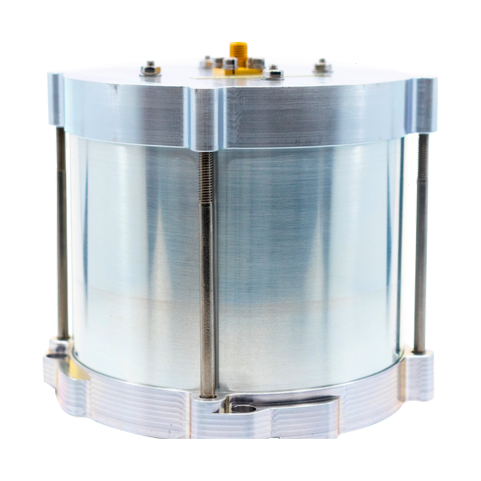 The Test Hat creates a controlled electromagnetic environment immediately surrounding the antenna aperture. Its body is a machined aluminium cavity lined with microwave absorber material. At the centre sits a calibrated RF probe whose coupling coefficient to the unit under test has been precisely characterised during Test Hat development.
When the RF chain transmits, the signal passes through the transceiver, harness, and antenna, then couples into the Test Hat probe. The received power level – measured at the Test Hat output port – gives you a calibrated, reproducible indication of the full RF chain performance: transceiver + harness + antenna, as a system.
Unlike an anechoic chamber measurement where accuracy depends on chamber calibration and alignment precision, a Test Hat measurement is inherently self-referencing. If the result for Unit #47 deviates from the acceptance reference on Unit #1, the difference is real.
What This Enables in Practice
Test Hats unlock several capabilities that would otherwise require anechoic chamber access. For a full breakdown of the pitfalls they address, see our article: 5 Common Pitfalls in Satellite Antenna Testing and How Test Hats Solve Them. Here are the key ones:
- Acceptance testing at unit level. Before an antenna is installed on the spacecraft panel, a Test Hat measurement verifies RF performance against specification without requiring a chamber. Deviations can be caught and resolved before integration, when rework is still manageable.
- Post-integration verification. After the antenna is mounted and the RF harness is connected, a Test Hat measurement confirms that nothing was degraded during installation. Connector torque issues, harness routing problems, or grounding faults show up immediately.
- Physical damage prevention. Repeatedly transporting a satellite to and from an anechoic chamber means repeated handling of sensitive radome surfaces. Scratches, dents, or scuffs can remove protective paint and shorten the antenna’s operational lifespan. Because Test Hats enable in-situ testing, they significantly reduce the amount of direct hardware handling required throughout the integration campaign.
- Operator safety. Working in or around an anechoic chamber with a powered transmitter carries real RF exposure risks for personnel, compounded by the constraints of manoeuvring large hardware in confined spaces. By enabling most end-to-end RF tests to be performed on the satellite platform directly, Test Hats reduce the time technicians spend in high-power environments and eliminate many of the heavy transport operations that create handling hazards.
- Regression testing after modifications. Every time a software update is loaded, a power system is modified, or any RF-adjacent hardware is reworked, a Test Hat measurement confirms that the RF chain is still nominal.
- Thermal-vacuum functional testing. Test Hats are designed to be used inside TVAC chambers, enabling end-to-end RF verification throughout environmental testing without requiring anechoic chamber access after TVAC.
- Constellation-scale production testing. For programs producing dozens of identical units, Test Hat measurements generate a consistent, comparable dataset across the whole batch. Unit-to-unit performance spread is immediately visible, and outliers are flagged before integration.
Anywaves Test Hat Range
- X-Band Test Hat – for single- and dual-circularly polarised X-Band antennas (7.9-8.5 GHz), covering TT&C downlink and uplink frequencies
- GNSS All-Band Test Hat – for navigation antennas covering GPS L1/L2, Galileo E1/E5, and GLONASS bands simultaneously (and more!)
- S-Band Test Hat – for S-Band TT&C antennas (1.98-2.29 GHz range)
RF Testing in Thermal-Vacuum: Where It Gets Really Hard
If conducted vs. radiated testing is the first challenge of RF EGSE, thermal-vacuum (TVAC) testing is the second, and in many ways the harder one.
TVAC testing subjects the spacecraft or subsystem to thermal cycling that simulates the orbital environment: cold soaks down to -100°C or beyond, hot soaks up to +100°C or more, with chamber pressure at or below 10&sup5; Torr.
The Cable Problem
Every RF connection between the spacecraft and the EGSE runs through the vacuum chamber wall via hermetically sealed feedthroughs. These introduce insertion loss and VSWR that vary with temperature. Cable runs from the satellite inside the chamber to measurement equipment outside can easily span several metres, with phase shifts and amplitude variations that track the cable temperature profile during thermal cycling.
Calibrating these losses at room temperature is straightforward. Calibrating them as a function of temperature is considerably harder: the gradient along the cable changes during each thermal ramp and the uncertainty compounds. The solution often involves placing in-situ power sensors inside the chamber, close to the satellite RF port, to eliminate cable loss uncertainty entirely.
The Outgassing Constraint
Any material placed inside a TVAC chamber must meet strict outgassing requirements, governed by ECSS-Q-ST-70-02C. For Test Hats and RF cables used inside TVAC chambers, standard commercial materials are often not acceptable. The absorber lining must be vacuum-compatible, cable jackets and connectors must use low-outgassing materials (typically PTFE-based), and even lubricants must be screened. Anywaves Test Hats used in TVAC configurations are developed with these constraints built in from the outset.
Functional Testing at Temperature Plateaus
ECSS standards require functional testing at defined temperature plateaus during TVAC cycling – at the operational cold case, the operational hot case, and at survival extremes. Test Hats remain attached to the antenna throughout the TVAC campaign. There is no need to open the chamber between plateaus to reconfigure the test setup, and results are directly comparable across temperatures because the test geometry has not changed.
TT&C Chain Validation: Closing the Loop
Validating the TT&C chain end-to-end requires the RF SCOE to simulate a complete ground station. Specifically, it must:
- Generate compliant uplink signals at the correct carrier frequency with the correct modulation scheme, at the correct power level – accounting for free-space path loss and cable losses
- Demodulate the downlink signal from the spacecraft transponder, extract the telemetry frame, and confirm frame synchronisation and error rates
- Perform the ESA/CCSDS ranging tone/code measurement to determine the link round-trip delay
- Run this closed-loop test both in conducted mode and in radiated mode via the spacecraft antenna, using a Test Hat or another coupling device
For S-band TT&C systems, the RF SCOE covers uplink frequencies in the 2025-2120 MHz range and downlink in the 2200-2290 MHz range. X-band systems operate at 7145-7235 MHz uplink and 8400-8500 MHz downlink. Frequency coordination must be completed before any radiated testing is conducted.
Putting It Together: A Layered RF Test Strategy
A robust RF test strategy is layered, not monolithic. The right approach uses complementary methods at each stage:
- At unit level, conducted measurements verify electronics performance, while Test Hat measurements verify the antenna itself.
- At subsystem level, conducted and Test Hat measurements combined verify that harness installation has not degraded performance.
- At system level, the full TT&C chain is validated in closed-loop mode – uplink, downlink, and ranging – in both conducted and radiated configurations.
- Throughout TVAC, functional RF tests are performed at each temperature plateau using the same Test Hat setup, generating a temperature-parametric dataset.
- At the launch site, a final Test Hat measurement before encapsulation confirms that nothing changed during transport and final integration.
This is what an RF EGSE strategy looks like in practice. Not one measurement at one point in time, but a continuous, traceable chain of RF verifications from first hardware to launch pad.
In the third article of this series, we will look at how this RF test strategy is developed and deployed in real programs, with a concrete look at the challenges being addressed in the REVALTO radar altimeter mission.
Discover our Test Hat product range