Compact X-Band Dual Polarized Antenna
Technical specifications
Double the data. Same footprint.
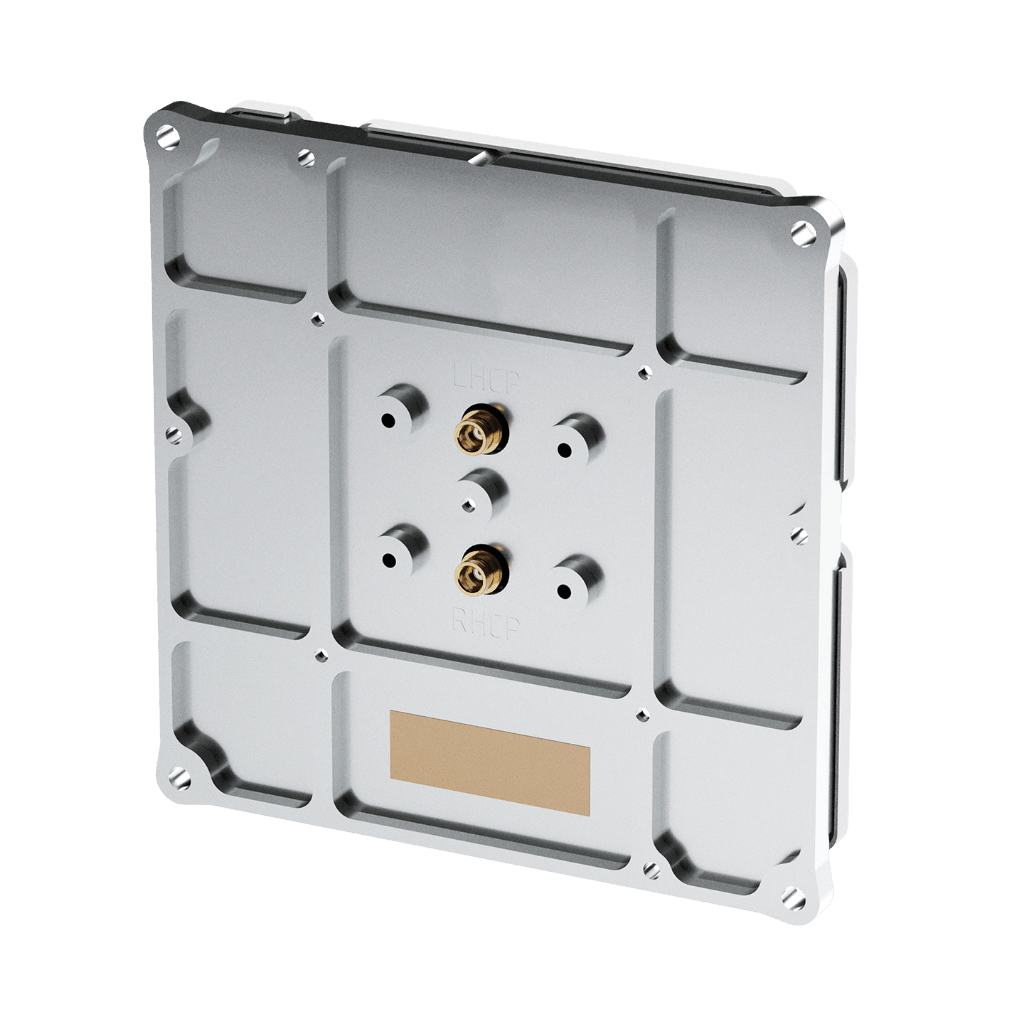
Simultaneous LHCP + RHCP — two connectors, one antenna
The Compact X-Band Dual-Polarized Antenna provides both LHCP and RHCP simultaneously on two dedicated SMA connectors. This makes it possible to either double the effective data rate by downlinking two independent data streams in parallel, or to use polarization diversity to mitigate signal fading and improve link reliability. Both configurations are supported with a single antenna unit.
ESD-free design for polar orbits and high altitudes
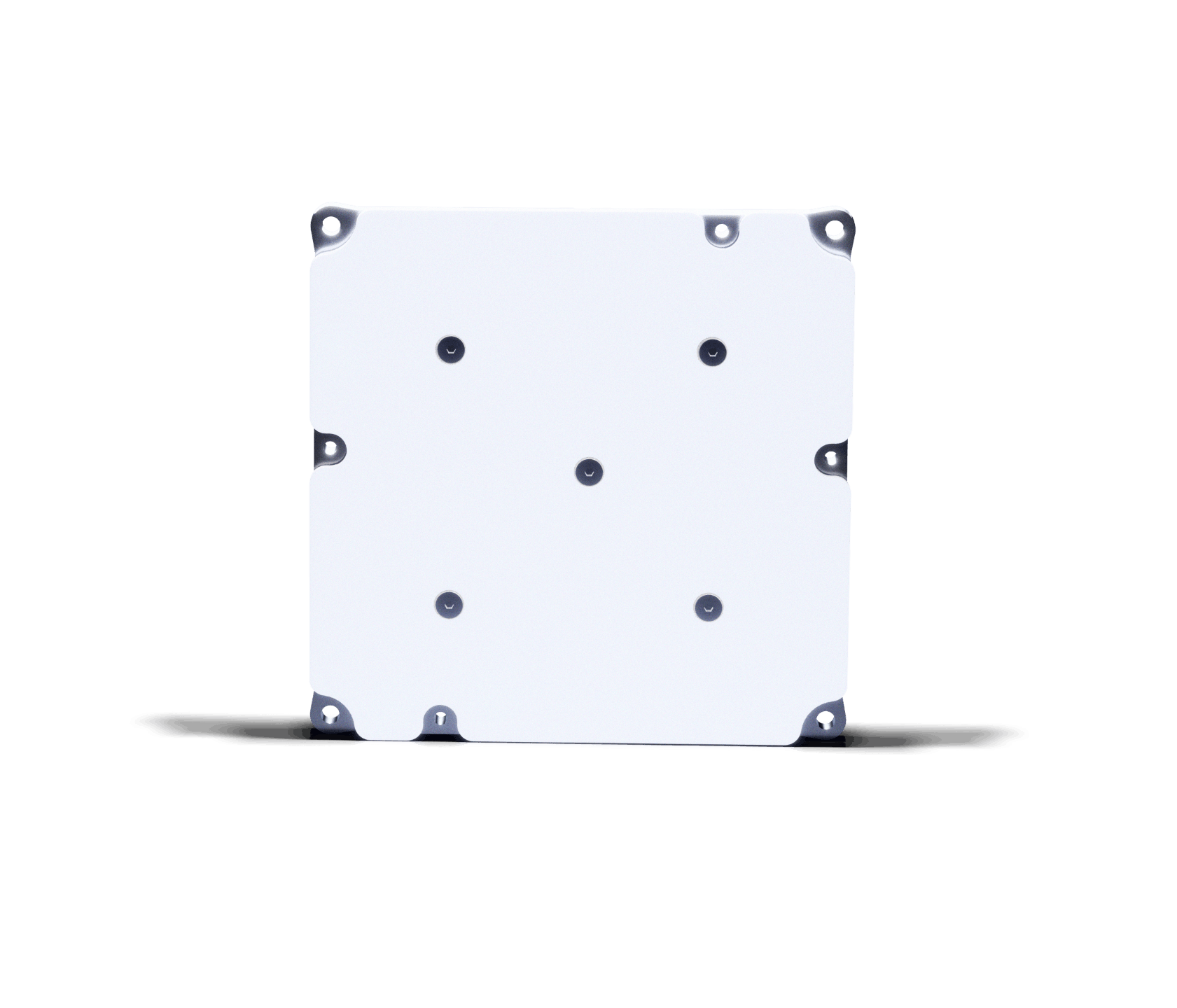
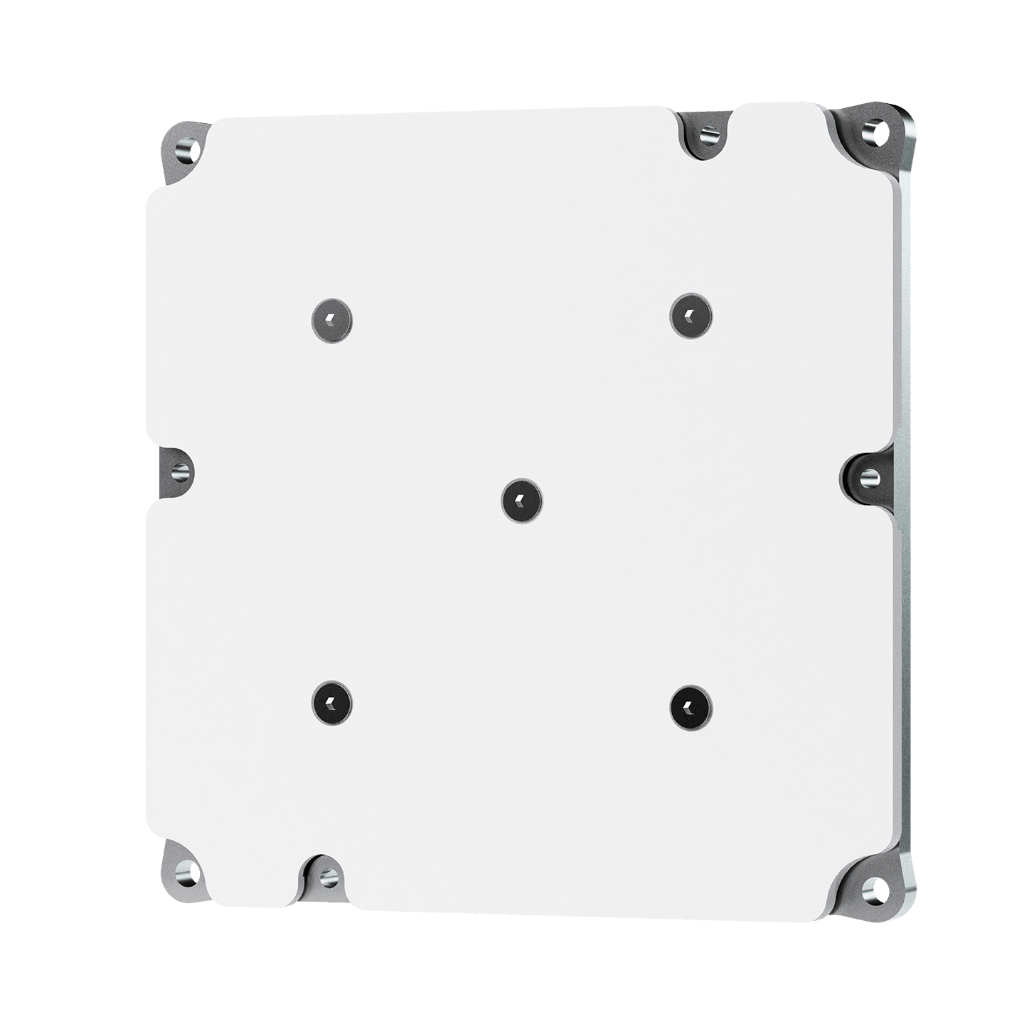
The antenna is protected by a PEEK radome coated with qualified anti-ESD white paint on flight models — specifically designed to prevent electrostatic discharge events, which are particularly critical for missions in polar orbits or above 400 km altitude. The radome also provides enhanced thermal protection of the antenna’s internal parts.
High-gain dual-pol in a 1U footprint
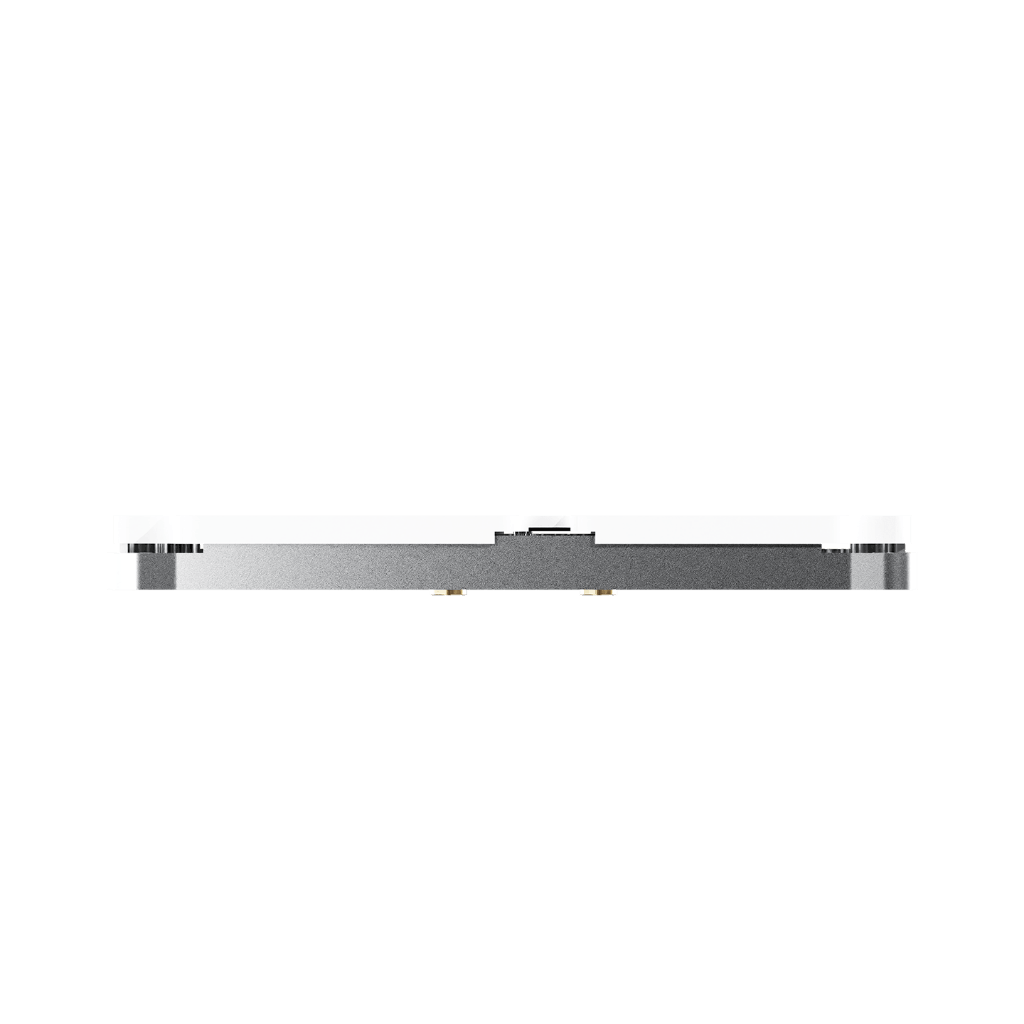
Despite offering simultaneous dual circular polarization, the Compact X-Band Dual-Polarized Antenna maintains the same 100 × 100 mm panel footprint as the single-polarization version, with an external protruding height of just 9.31 mm. At 153 g, it delivers a gain exceeding 15.5 dBi at 8.2 GHz with an axial ratio below 1 dB at boresight — combining the performance of a dual-polarization system with the mass and size constraints of a nanosatellite platform.
More data per pass — without a larger footprint
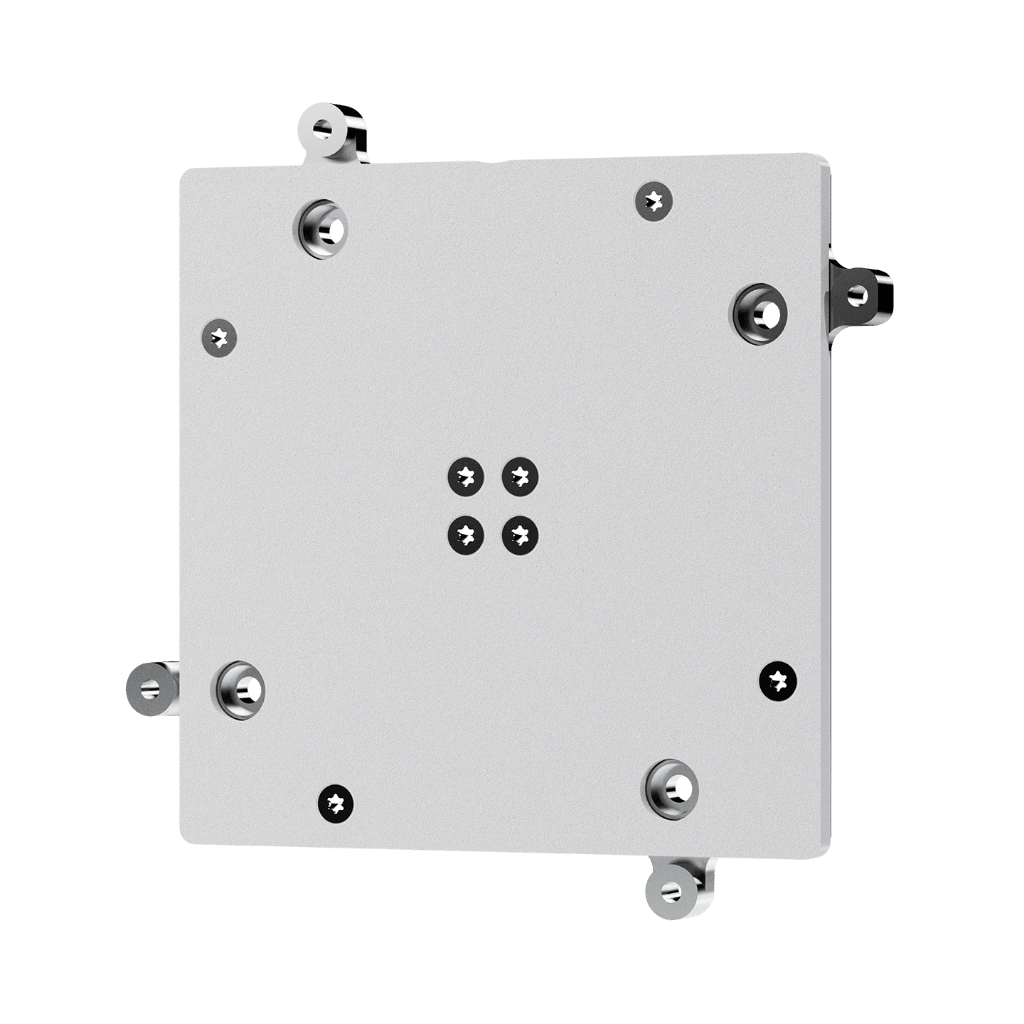
The Anywaves Compact X-Band Dual-Polarized Antenna delivers simultaneous LHCP and RHCP from a single 100 × 100 mm antenna aperture. Operating from 8.025 to 8.4 GHz, it enables either doubled data throughput — by streaming two independent mission datapacks in parallel — or polarization diversity for improved link reliability.
Derived from the flight-proven Compact X-Band Antenna architecture, it features high cross-polar discrimination and port-to-port isolation better than −15 dB, ensuring clean independent signals on each connector. The PEEK radome with anti-ESD coating provides full protection against electrostatic discharges, critical for missions in polar orbits or above 400 km. Compatible with the Anywaves Test Hat for X-Band Antennas. ITAR Free. Full acceptance testing on flight models.

Complete EIDP
At the delivery of your antennas, you will receive a complete EIDP (End Item Data Package) including: RF acceptance test reports, ICD (Interface Control Document), Mechanical envelope, User Manual, Certificate of conformity.

In-Depth Engineering Support
During the full length of your antennas project, you’ll benefit from an in-depth and tailored support from our experienced engineers. They’ll answer all of your questions and ensure that our antennas meet your missions’ needs.

Further Testing Available On Demand
If needed, we can perform additional on-demand tests on your antennas to guarantee their performance in the specific environment and conditions of your spacecraft.

Specific Requests Analysis With Experts
In the case you need additional information and performance results, our experts can conduct complementary analysis based on your requirements (mechanical, thermal, radio-frequency performances on platform etc.).

Two polarizations. One antenna. Twice the data.
Tell us about your payload and downlink architecture. Our engineers will help you make the most of dual-polarization X-Band for your mission.
Questions & Answers
-
What is the difference between the Compact X-Band Antenna and the Compact X-Band Dual-Polarized Antenna?
The two antennas share the same 100 × 100 mm footprint and are based on the same architecture, but the Dual-Polarized version adds a second SMA connector providing the orthogonal circular polarization simultaneously. The single-polarization Compact X-Band Antenna is available in LHCP or RHCP (one connector, one polarization), while the Dual-Polarized version delivers both LHCP and RHCP at the same time (two connectors, two simultaneous polarizations). The trade-offs are a slightly greater thickness (26.8 mm vs 16 mm total height), higher mass (154g vs 70 g), and a narrower frequency band (8.025–8.4 GHz vs 7.9–8.5 GHz).
-
How can dual polarization double the data rate?
By providing LHCP and RHCP simultaneously on two separate connectors, the Compact X-Band Dual-Polarized Antenna allows two independent data streams to be transmitted at the same time on the same frequency — one on each polarization. Since the two polarizations are orthogonal and well-isolated (port-to-port isolation better than −15 dB), a dual-polarization ground station can receive both streams without crosstalk, effectively doubling the total data volume transferred during each pass compared to a single-polarization link.
-
What is polarization diversity and when is it useful?
Polarization diversity is a technique where a transmitter sends the same signal on two orthogonal polarizations simultaneously (or switches between them), and the receiver selects or combines the stronger signal. It is particularly useful for links that experience polarization fading — a degradation of the received signal due to Faraday rotation in the ionosphere or multipath effects. Rather than doubling throughput, polarization diversity improves link reliability and availability, which is valuable for critical TT&C or telemetry links on LEO satellites.
-
Why is anti-ESD protection important for this antenna?
Electrostatic discharge (ESD) is a significant risk for satellites in polar orbits or above 400 km altitude, where the spacecraft is exposed to intense particle fluxes from the magnetosphere and solar wind. These can cause surface charging on antenna radomes, leading to sudden discharges that can damage RF components or generate electromagnetic interference. The Compact X-Band Dual-Polarized Antenna is coated with a qualified anti-ESD white paint on its PEEK radome, dissipating surface charges continuously and preventing discharge events throughout the mission.
-
Can I use only one polarization at a time with the Dual-Polarized Antenna?
Yes. Each connector can be used independently. If your system architecture only requires single-polarization downlink, you can connect only one port and terminate the other with a 50Ω RF load. The antenna will operate normally in single-polarization mode. This makes the Dual-Polarized version backward-compatible with single-polarization RF chains, providing flexibility to upgrade the ground segment later without changing the flight hardware.
-
Is the Compact X-Band Dual-Polarized Antenna compatible with the Anywaves Test Hat?
Yes. The antenna is compatible with the Anywaves Test Hat for X-Band Antennas, allowing RF functional testing of both polarization ports while the antenna is already integrated on the spacecraft. This significantly simplifies RF verification during final integration and at the launch site, without requiring demounting.
Compact X-Band dual-polarized antenna: simultaneous LHCP & RHCP for high-data-rate downlink
The Anywaves Compact X-Band Dual-Polarized Antenna is a TRL 8 data downlink antenna for LEO satellites, providing simultaneous LHCP and RHCP on two dedicated SMA connectors from a single 100 × 100 mm footprint. Operating from 8.025 to 8.4 GHz (375 MHz bandwidth), it delivers a realized gain exceeding 15.5 dBi at 8.2 GHz with an axial ratio below 1 dB from 0° to ±5° and port-to-port isolation better than −15 dB. The dual-polarization capability enables either doubled data throughput — by streaming two independent payloads in parallel — or polarization diversity for improved link reliability.
At 140 g and 8.7 mm of protruding height, the antenna fits within a 1U CubeSat face. The PEEK radome is coated with qualified anti-ESD white paint on flight models, providing full protection against electrostatic discharges — particularly critical for polar orbits and missions above 400 km altitude. Qualification temperature: −120°C to +120°C. 20 W power handling (1×20 W or 2×10 W). Acceptance testing (RF, mechanical and thermal) included on all flight models. Compatible with the Anywaves Test Hat for X-Band Antennas. ITAR Free.
