Quad-Ridged Horn Antenna
Typical design targets — each antenna is designed to your specifications
100% bandwidth. Dual polarization. Full metal. From S to X band.
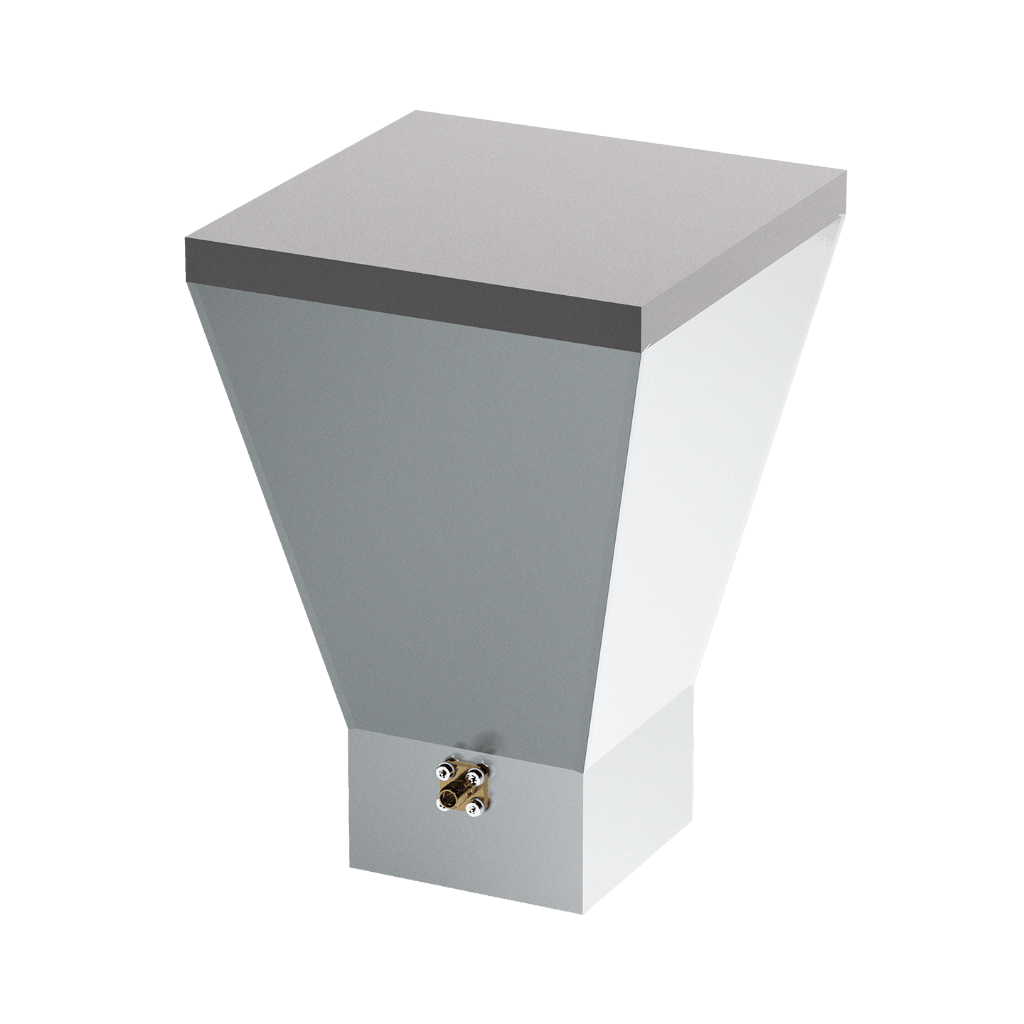
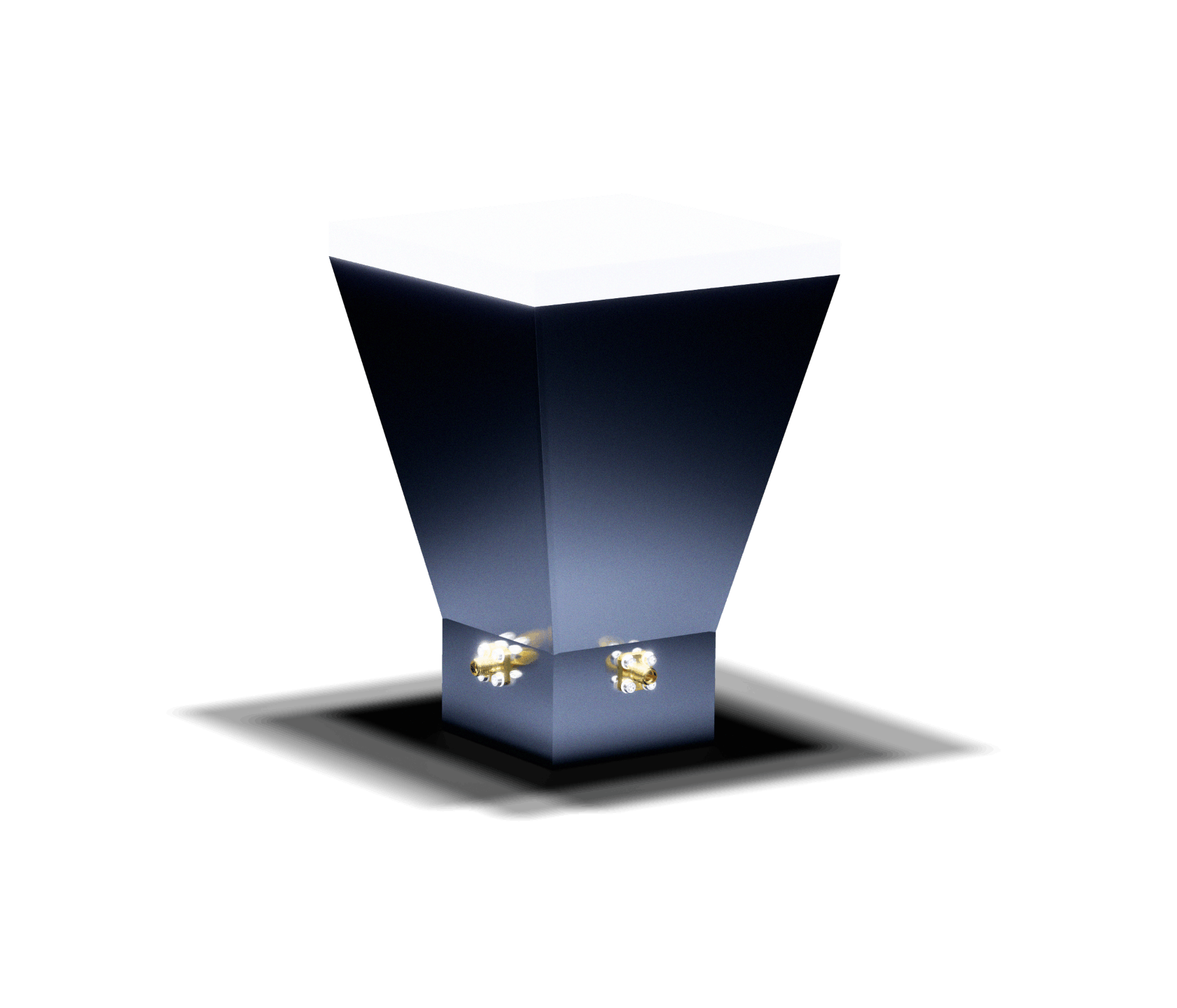
Quad-ridged horn — 100% fractional bandwidth, S to X band
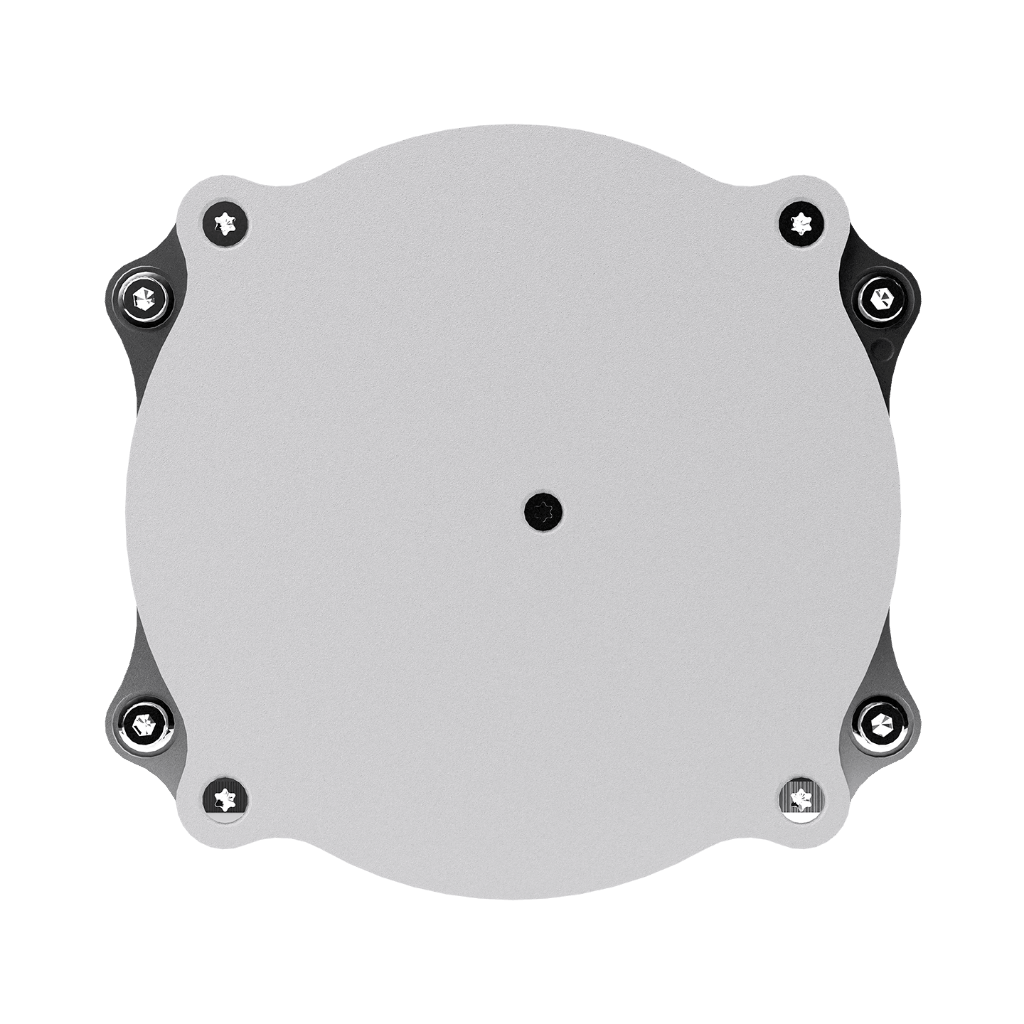
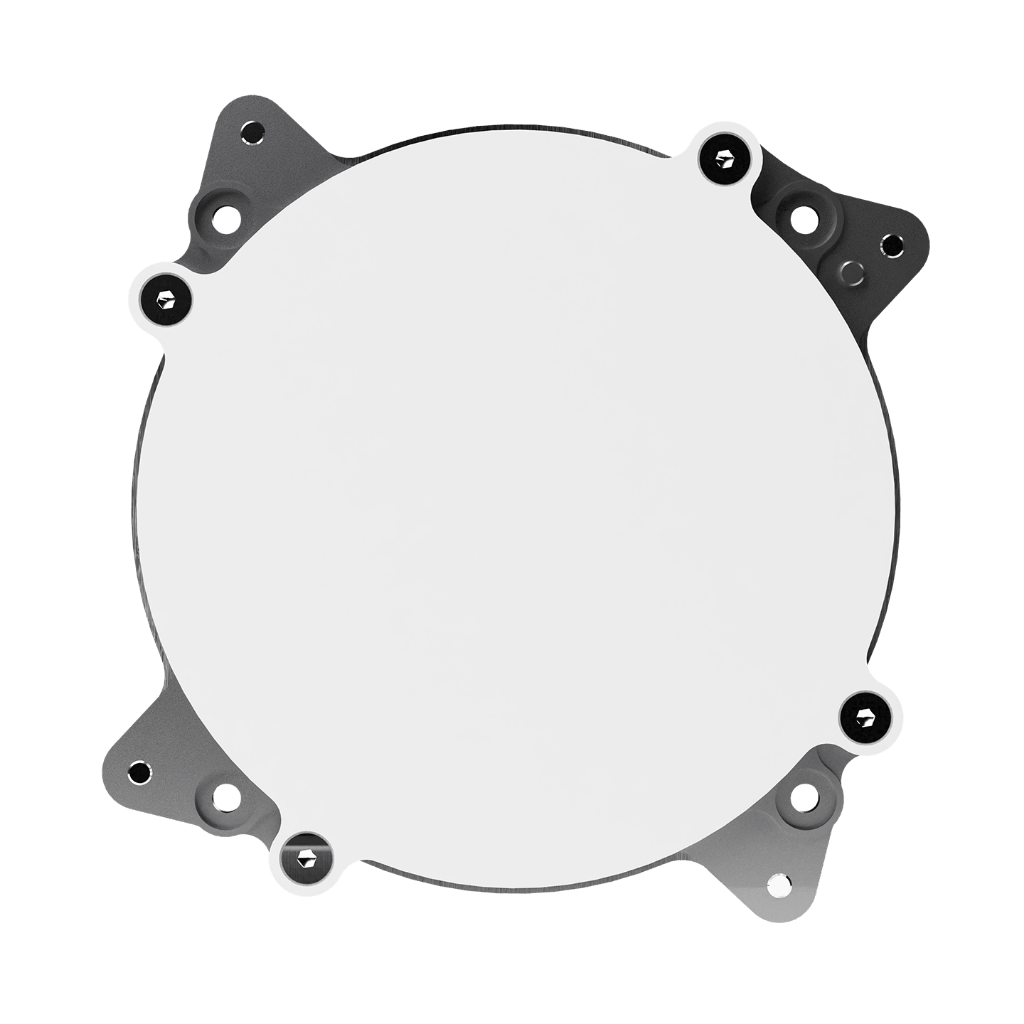
The quad-ridged horn architecture achieves a 100% fractional bandwidth from S to X band — a coverage range of more than two octaves — through the progressive tapering of four conductive ridges that control the transition of the wave from the waveguide to the aperture. This architecture enables simultaneous reception or transmission across the full target frequency range without the resonance-based limitations of patch or dipole antennas. Two size versions are available: a larger S+C band version (below 110 × 110 × 200 mm) and a more compact C+X band version (below 60 × 60 × 150 mm).
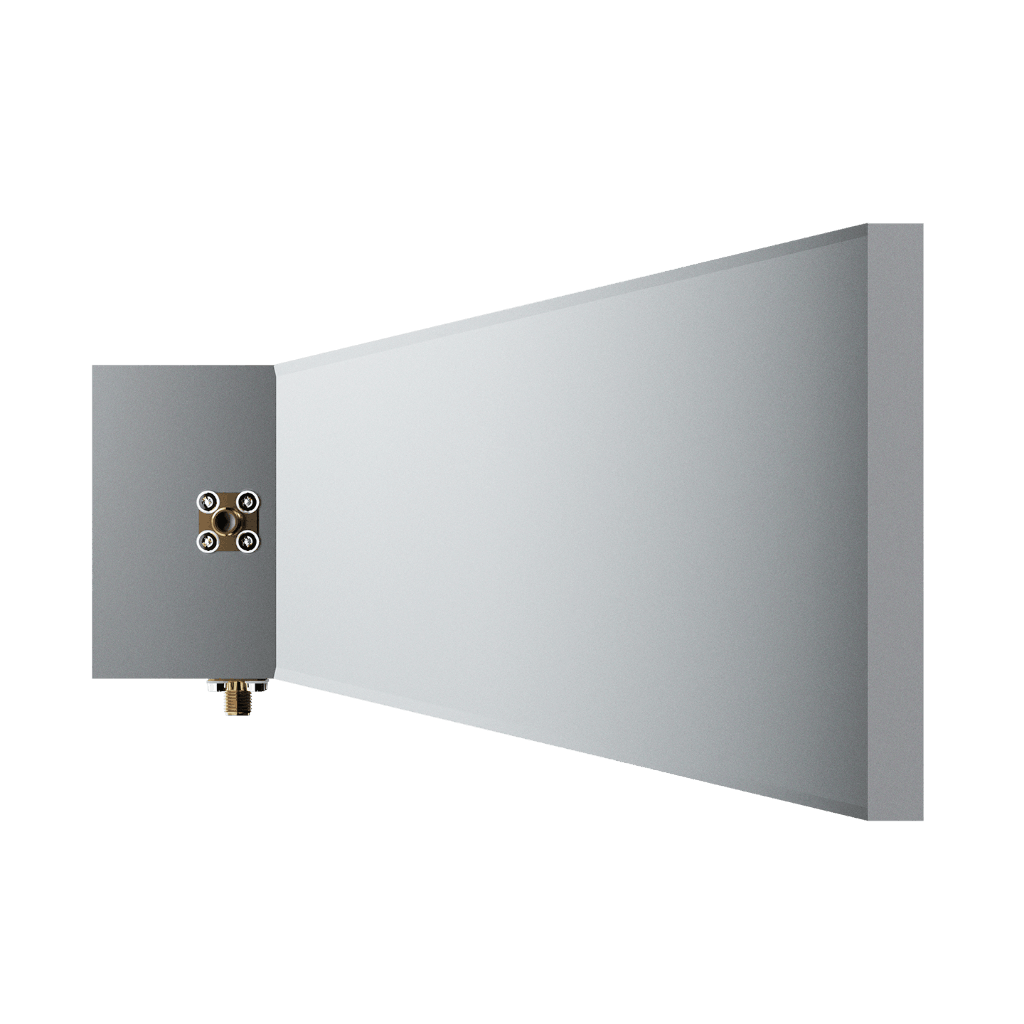
Full-metal structure — ESD-free, >90% radiation efficiency
The Quad-Ridged Horn Antenna is manufactured entirely from space-qualified metal. This full-metal architecture eliminates ESD phenomena — a critical advantage for spectrum monitoring payloads in LEO where electrostatic discharges can corrupt the received signal or damage the payload electronics. It also provides exceptional radiation efficiency: the C+X band version achieves above 90%, meaning that virtually all the power fed to the antenna is radiated rather than dissipated. The absence of any dielectric material removes the insertion losses and thermal degradation modes that limit the efficiency of printed or patch-based wideband antennas.
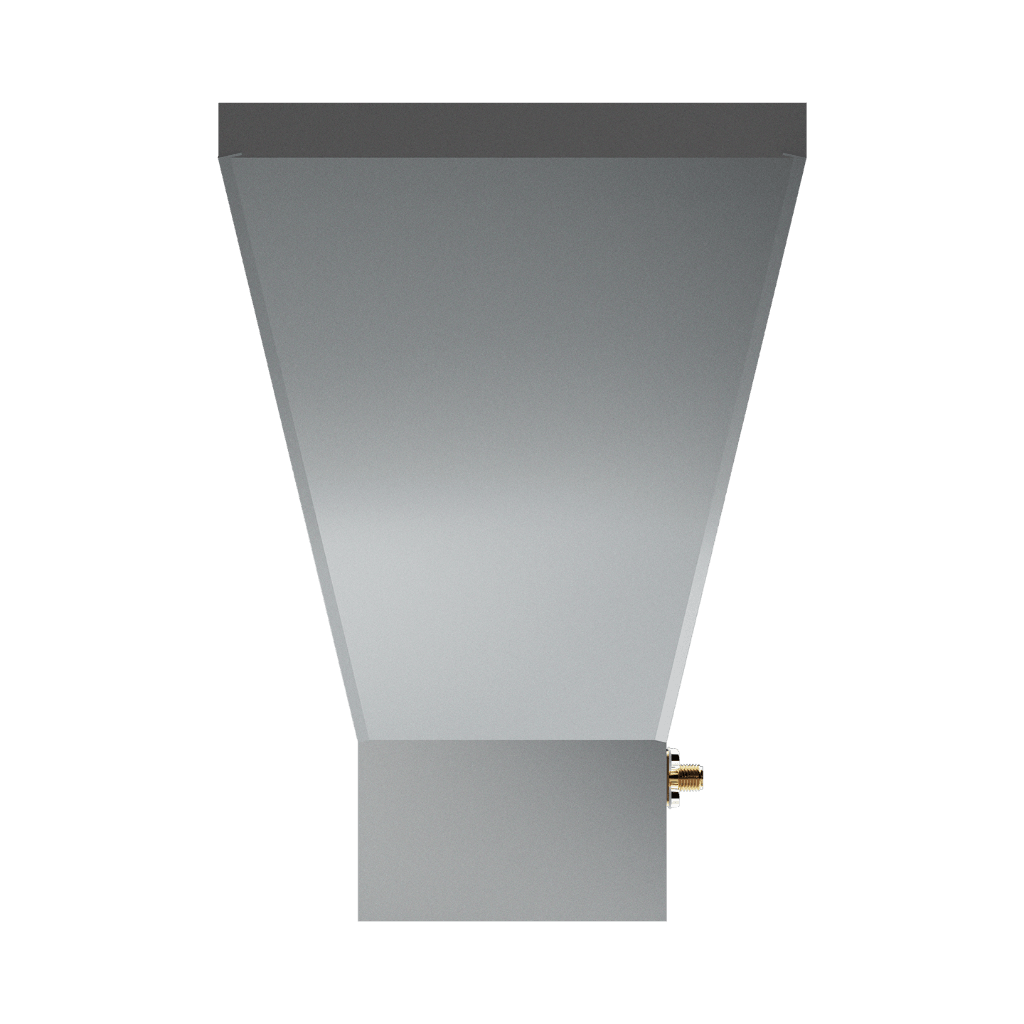
Dual linear and circular polarization — one antenna, all polarization modes
The quad-ridged horn architecture supports both dual-linear polarization (two orthogonal linear components simultaneously) and dual-circular polarization (LHCP and RHCP simultaneously), from a single aperture. This polarization versatility makes it suitable for a wide range of spectrum monitoring and SSA scenarios: monitoring linearly polarized ground signals, receiving circularly polarized GNSS signals, characterising unknown polarization states of debris or interference sources, and implementing polarimetric signal processing techniques to improve target discrimination. All from the same antenna, without hardware reconfiguration.
Wideband spectrum capture with medium gain and full polarization agility
The Anywaves Quad-Ridged Horn Antenna is a custom-designed, full-metal wideband antenna for satellite payload applications requiring simultaneous coverage of a wide frequency range with medium gain and full polarization agility. Available in two size variants — S+C band (>6 dBi, below 110 × 110 × 200 mm) and C+X band (>8 dBi, below 60 × 60 × 150 mm) — it covers 100% of fractional bandwidth within each configuration, making it the right choice for spectrum surveillance, SSA and GNSS augmentation payloads that need to capture signals across a wide frequency range from a single aperture.
Its full-metal quad-ridged horn architecture achieves above 90% radiation efficiency (C+X band version), is inherently ESD-free, and supports dual linear and circular polarization simultaneously. This polarization versatility enables complex signal processing techniques — from simple circular polarization reception for GNSS to fully polarimetric characterisation of unknown signals. All parameters are defined jointly with the customer. Qualification campaign included. ITAR Free.

Requirement Definition
At Anywaves, we specialise in delivering custom-made antennas tailored to meet your unique requirements. Our expertise allows us to understand your specific needs and translate them into antenna specifications. We work closely with you to identify key parameters such as frequency bands, gain, beamwidth, mechanical constraints, and environmental considerations. Our team of experienced engineers collaborates with you throughout the process, ensuring that the antenna design aligns precisely with your application’s demands.

Project Management
Our experienced space project managers are skilled in coordinating all aspects of your custom-made antenna project, from initial concept to final delivery. With meticulous planning, effective communication, and diligent resource allocation, we ensure that your project stays on track through key milestones (PDR, CDR, TRR, TRB…). Our project management expertise enables us to navigate complex challenges, mitigate risks, and provide you with regular updates on project progress.

Technical Expertise
Our team of skilled engineers has extensive experience in antenna design and development, as well as in the space and defence industries. We leverage the latest tools and technologies to develop innovative antenna solutions that meet even the most complex challenges. With our technical expertise, we optimise key parameters such as gain, bandwidth, radiation pattern, and impedance matching to deliver antennas that excel in your specific application, following an extensive testing process to mitigate risks throughout the project.

Extensive Documentation
In addition to our standard EIDP package, we deliver throughout the project all the design justification you may need: RF, mechanical, thermal and radiation analyses; test plans; test reports. We make sure to deliver documentation that adds value to your project and guarantees that your antenna is compliant with your requirements.

Tell us your frequency range and polarization needs. We’ll design the horn.
Share your target frequency band, gain specification and platform constraints. Our RF engineers will design a Quad-Ridged Horn Antenna in the right size variant for your spectrum monitoring or SSA mission.
Questions & Answers
-
What is a quad-ridged horn antenna and how does it work?
A quad-ridged horn antenna is a type of broadband horn antenna in which four conductive ridges are arranged symmetrically inside a tapered rectangular or square waveguide, pointing towards the aperture. The ridges progressively load the waveguide cross-section as the wave travels from the input port to the aperture, lowering the cutoff frequency of the fundamental mode and extending the operating bandwidth far beyond what a standard unridged horn can achieve. The result is a single-aperture antenna capable of 100% fractional bandwidth — two or more octaves of frequency coverage — with consistent gain and impedance matching across the full range. The four-ridge arrangement also supports two orthogonal polarizations simultaneously, enabling dual-linear and dual-circular polarization operation from the same port pair.
-
What is the difference between the Quad-Ridged Horn Antenna and the Compact Wideband Antenna?
Both products target spectrum monitoring, SSA and GNSS augmentation applications, and both achieve up to 100% fractional bandwidth. The fundamental difference is architecture and form factor. The Compact Wideband Antenna is flat and cavity-backed: it fits within a <1U panel footprint, has a wide hemispherical radiation pattern (gain below 3 dBi), and covers UHF to S-band. It is optimised for maximum bandwidth in the smallest possible volume. The Quad-Ridged Horn is a 3D tapered horn: it is physically larger (up to 200 mm tall), achieves higher gain (above 8 dBi in the C+X version), covers S to X band, and supports dual-linear as well as dual-circular polarization. It is optimised for medium-gain directive signal capture with full polarization agility. The choice depends on the mission’s frequency range, gain requirement, polarization needs and available accommodation volume.
-
Why does dual polarization matter for spectrum monitoring?
Most spectrum monitoring applications require characterising signals whose polarization state is unknown — interference sources, active debris, out-of-band emissions. A single-polarization antenna can only measure one component of the incoming electric field and will miss or mischaracterise signals in the orthogonal polarization. A dual-polarization antenna captures both components simultaneously, enabling the satellite to (1) receive any polarization without loss, (2) perform polarimetric processing to characterise the polarization state of unknown signals, and (3) separate LHCP and RHCP components for GNSS and communications signals respectively. The Quad-Ridged Horn supports both dual-linear and dual-circular polarization from the same aperture, giving maximum flexibility in signal processing.
-
Which variant should I choose: S+C band or C+X band?
The choice depends on your mission’s target frequency range. The S+C band version (below 110 × 110 × 200 mm, above 6 dBi) covers the S-band (around 2–4 GHz) and C-band (around 4–8 GHz), which includes satellite TT&C frequencies, mobile satellite services, and weather satellite downlinks — a natural target for spectrum surveillance of terrestrial and satellite emitters in the S and C allocations. The C+X band version (below 60 × 60 × 150 mm, above 8 dBi) covers C-band and X-band (around 8–12 GHz), which includes Earth observation satellite downlinks, X-band radar signals and weather radar — more relevant for EO satellite monitoring, debris detection at higher frequencies, or GNSS augmentation combined with X-band payload monitoring. Anywaves engineers can also discuss custom frequency combinations if neither standard variant matches your requirements.
-
How does the Quad-Ridged Horn Antenna compare to the Compact Wideband Antenna for GNSS augmentation?
For GNSS augmentation specifically, the two products address different scenarios. The Compact Wideband Antenna (UHF to S-band) covers all GNSS frequency bands from L1 to L5/E5, including L-band PPP correction signals — making it the better choice if the mission needs to receive GNSS signals themselves as a primary function. The Quad-Ridged Horn (S to X band) does not cover the GNSS L-band frequencies (around 1.2–1.6 GHz) directly in its standard configurations, but the S+C band version starts from approximately 2 GHz and can be designed to extend down into L-band in a custom configuration. Contact Anywaves engineers to discuss GNSS augmentation requirements that fall outside the standard frequency ranges.
Quad-ridged horn antenna: wideband dual-pol for spectrum monitoring and SSA
Anywaves’ Quad-Ridged Horn Antenna is a custom-designed, full-metal wideband antenna for satellite payload applications in spectrum monitoring, Space Situational Awareness (SSA), GNSS augmentation and spectrum surveillance. Based on a quad-ridged horn architecture, it achieves 100% fractional bandwidth from S to X band with dual linear and circular polarization from a single aperture. Available in two size variants: S+C band (above 6 dBi boresight gain, below 110 × 110 × 200 mm) and C+X band (above 8 dBi, below 60 × 60 × 150 mm, above 90% radiation efficiency).
The full-metal construction — space-qualified metal throughout, no dielectric in the RF path — ensures ESD-free operation and very low insertion losses, critical for accurate wideband signal characterisation in LEO. All parameters (frequency band, gain, size, mechanical interface) are defined jointly with the customer. TRL 8. Qualification campaign includes vibration testing, shocks, and thermal vacuum cycling. Acceptance tests included. ITAR Free.
