After a two-year-long journey through the inner solar system, Hera is finally arriving at its destination: the Didymos binary asteroid system. As a partner mission to NASA’s DART spacecraft, this is humankind’s first dual-spacecraft mission for planetary defence, tackling one of Earth’s biggest threats: asteroid impact.
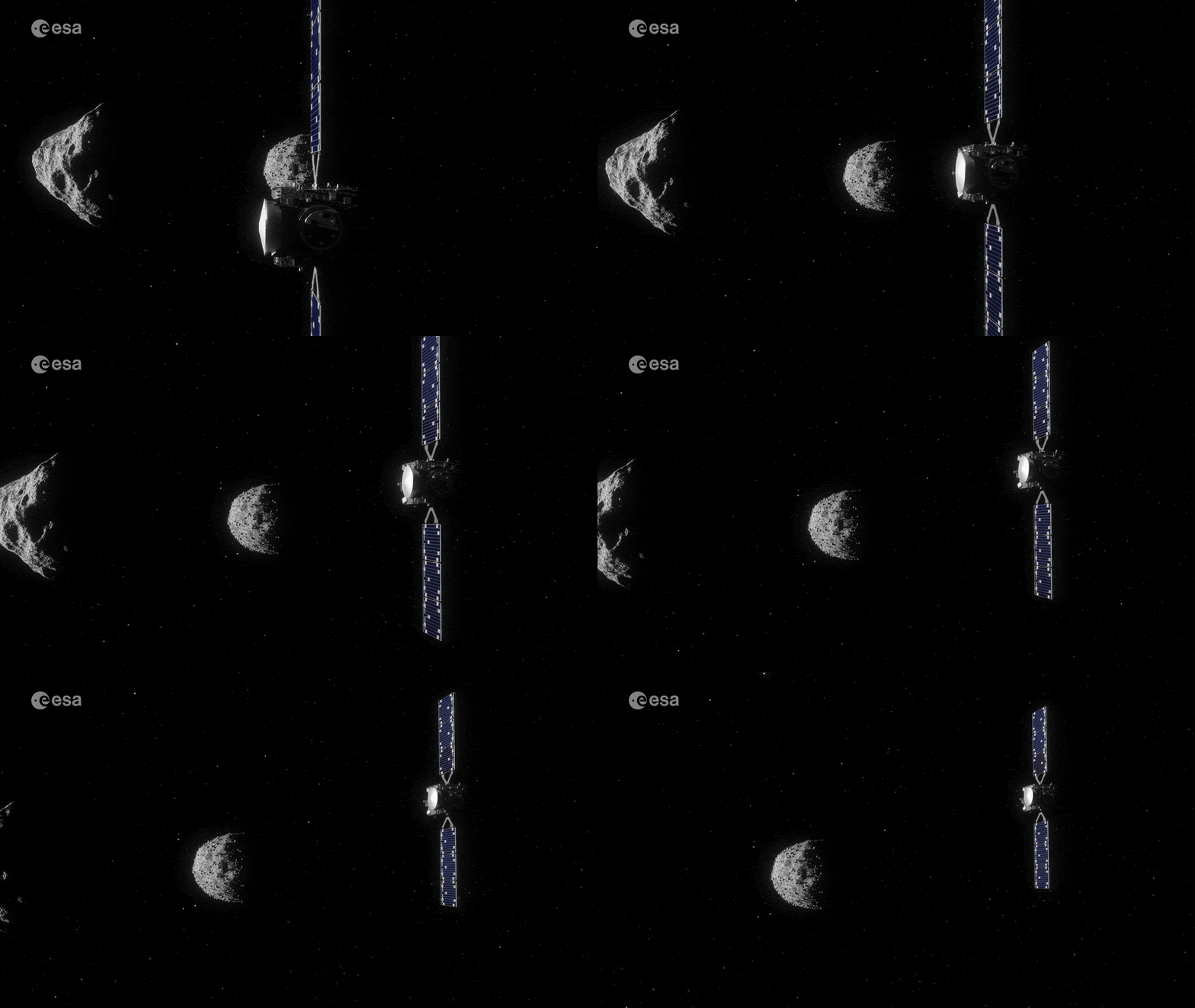
With around 40,000 detected Near-Earth Asteroids (NEAs) and current models suggesting this is only 30% of the total (Source: ESA), this class of asteroids can no longer afford to be understudied. This gap in planetary defense knowledge and strategies is exactly the goal of this mission.
Over the last 26 months, Hera has carried out deep-space maneuvers, a Mars flyby for a gravity assist and rigorous systems testing. Most recently, the final braking sequences were performed to formally end its cruise, slowing down enough for the asteroid system’s gravity to catch it into orbit. The spacecraft will now study the binary asteroid system in pioneering detail, mainly focusing on the previously impacted moonlet in the system, Dimorphos.
In previous blogs, we introduced the mission’s background and took a deep dive into the Anywaves technology onboard: the JuRa radar on the Juventas CubeSat and the S-Band TT&C antennas on all three satellites. This article will celebrate Hera’s arrival by exploring the vital science Hera will carry out over its remaining mission lifetime. While the data from this mission will rewrite the books on planetary science and future satellite engineering, access to this data relies entirely on the invisible umbilical cord of Anywaves’ S-Band antennas.
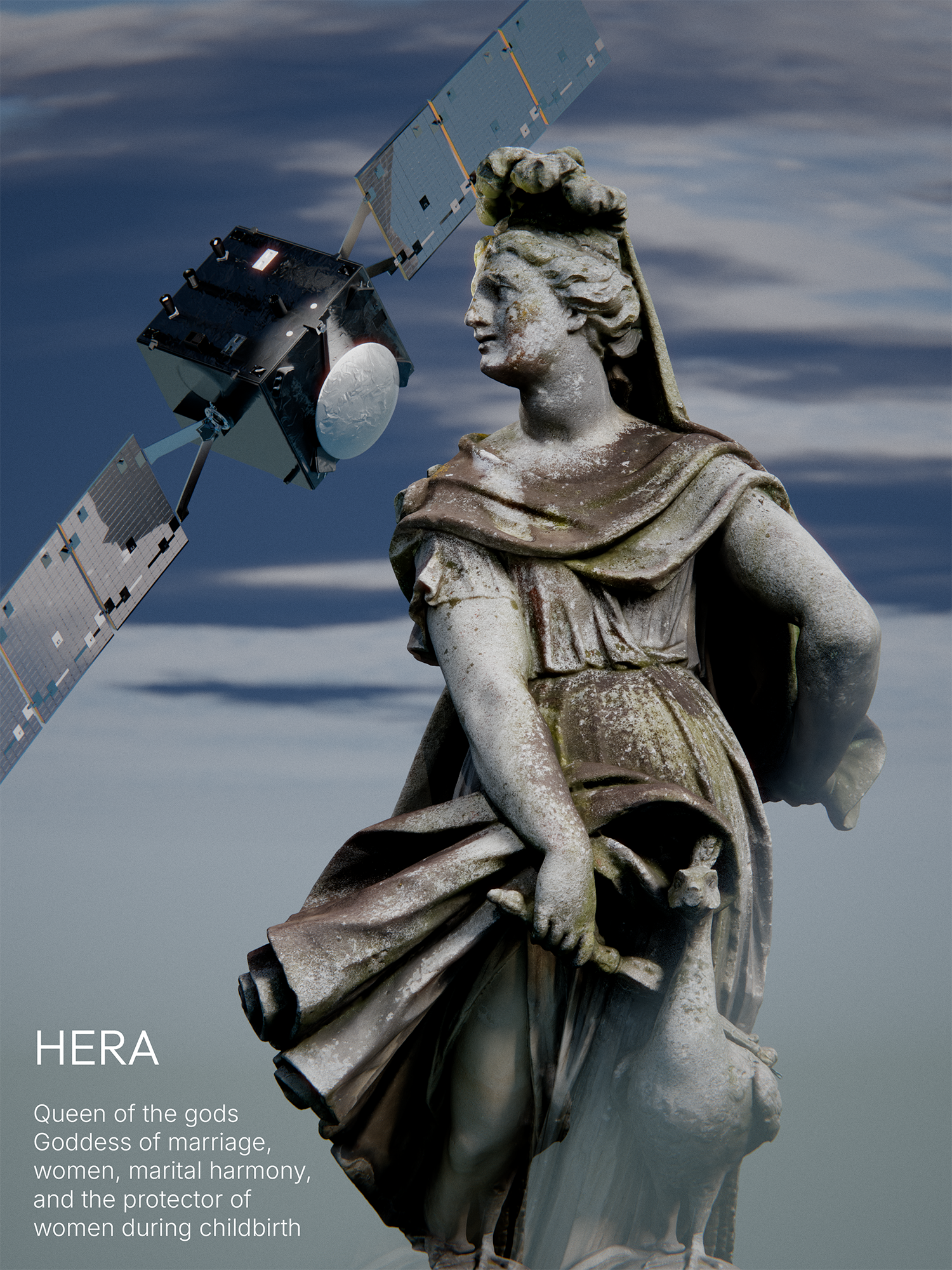
Did you know: Hera is named after the Greek goddess of marriage, representing its compatibility with DART and dedicated purpose in completing the overall goal of the Asteroid Impact & Deflection Assessment (AIDA), the joint planetary defense mission by ESA and NASA to test asteroid deflection characterisation.
The Physics of the Impact
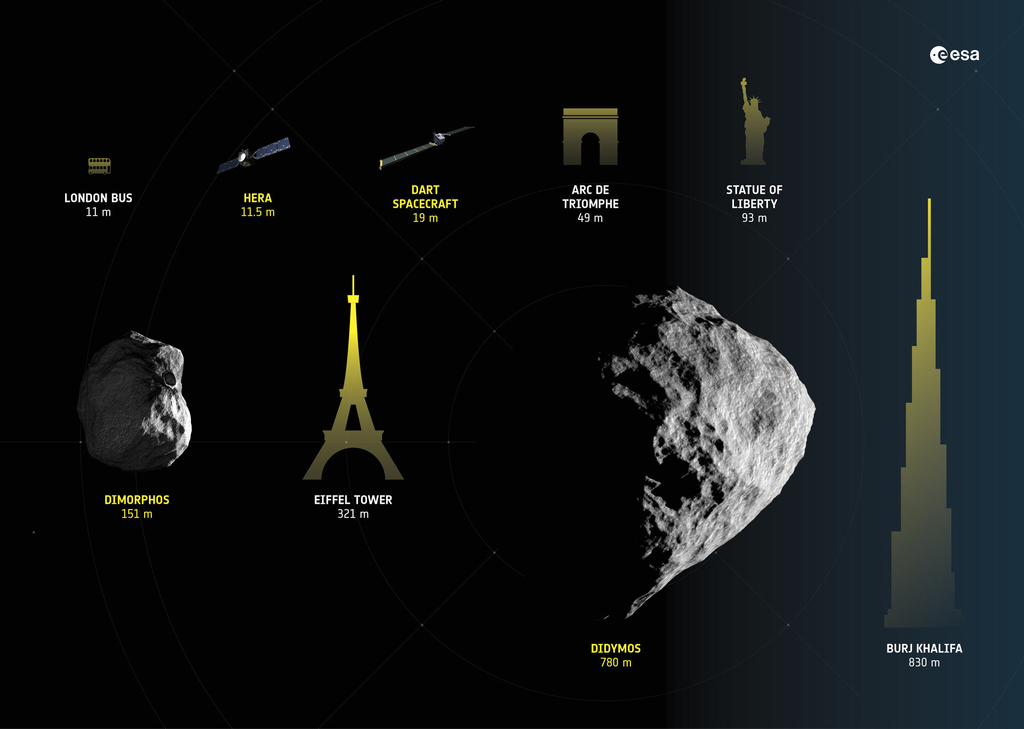
NASA’s Double Asteroid Redirection Test (DART) impacted the 151 m wide moonlet Dimorphos in September 2022. This was a world-first demonstration of asteroid deflection technology, a kinetic impactor that successfully shortened the moonlet’s orbit around Didymos by 32 minutes. The goal of this impact was to help advance theoretical asteroid deflection models. However, there is a lot more physics that goes into understanding the true consequences of this impact.
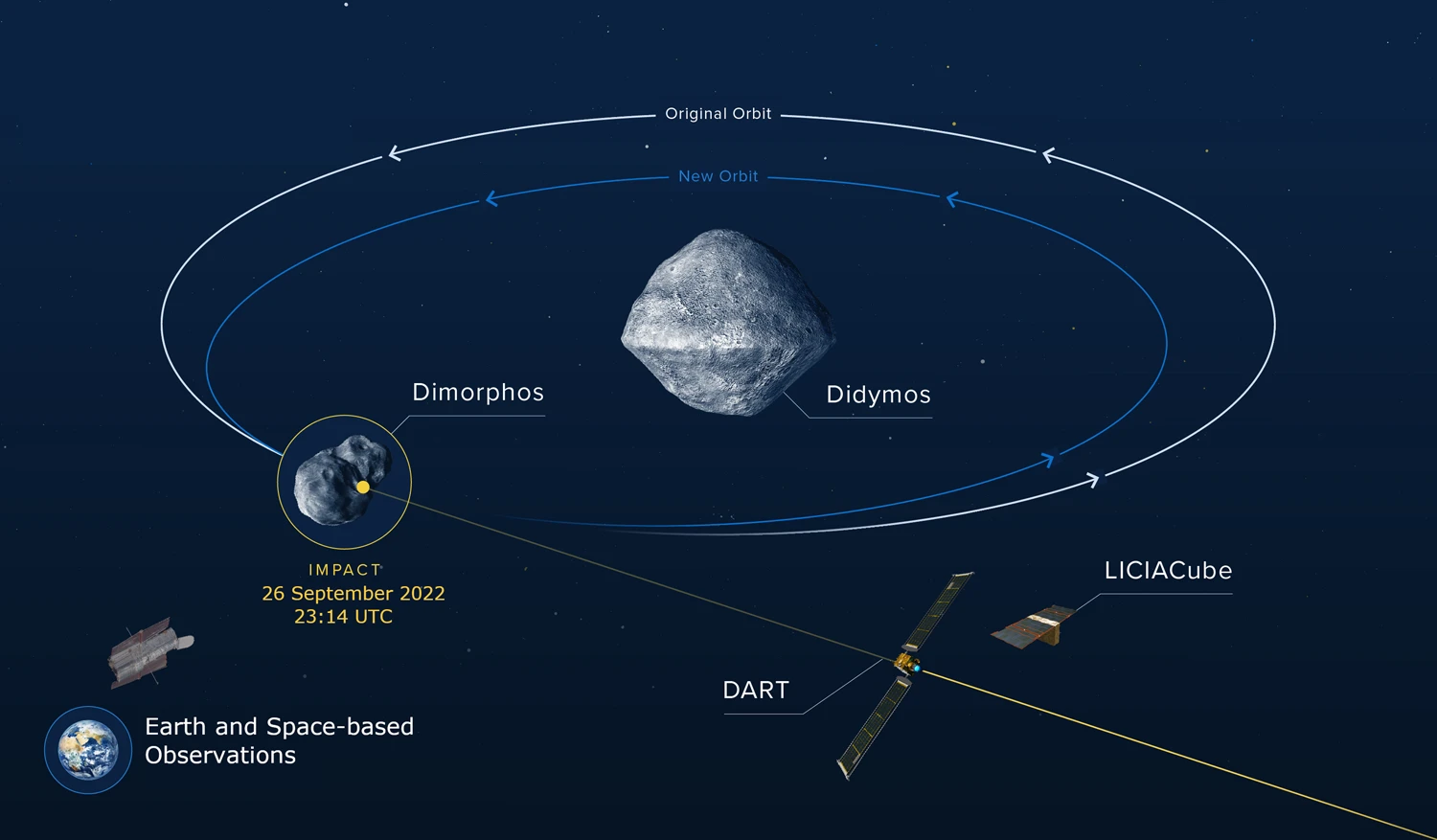
The momentum transfer from the collision is the key to answering a critical question: What specific mechanism dominated the kinetic deflection? To understand this, some basic physics is required.
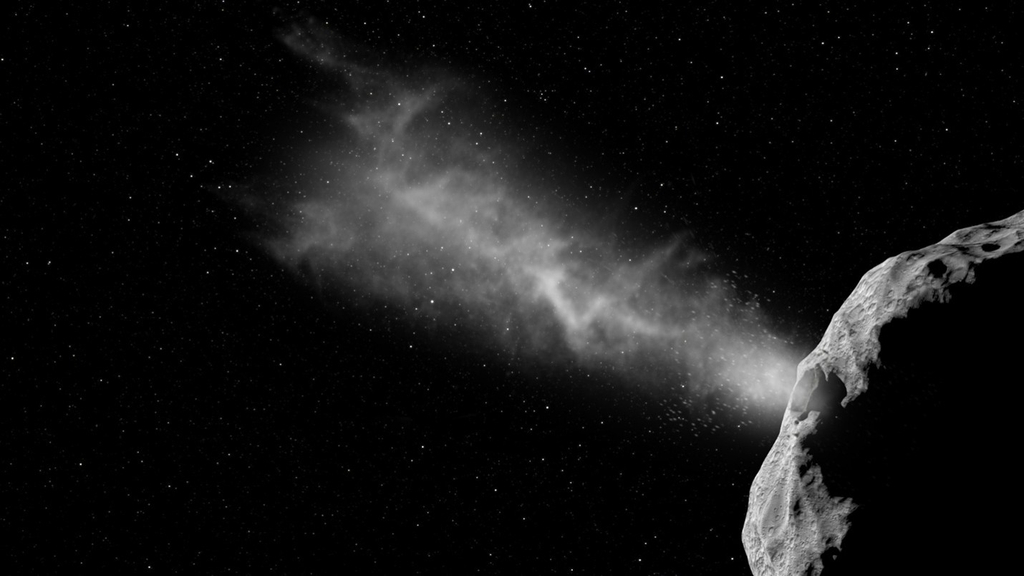
When two objects collide, momentum passes from one to another. The force they exert on each other causes their post-contact motion to differ from their motion before. However, the initial crash isn’t the only source of push for the asteroid. The spacecraft also throws material off the asteroid, which carries momentum away and gives the remaining asteroid an extra recoil. This is, in principle, similar to the mechanics of a rocket launch, which uses mass ejected in one direction to gain momentum in the other.
Physics tells us that momentum is conserved in a collision, so DART’s kinetic energy was likely converted into other forms:
- Deformation
- Fracture
- Internal heat
- Moving debris
Hera’s goal is to quantify how much of the push came from DART itself versus the recoil of ejected material, a ratio expressed by the momentum enhancement factor (β).
This evaluation will help engineers calculate a precise value for β rather than relying on DART estimates. This metric will determine which factor dominated the successful shift of the moonlet: the physical mass of DART, or the massive recoil of ejected debris.
Importantly, momentum is a measure of mass and velocity. We know these variables precisely for DART but we have massive gaps in our knowledge for Dimorphos, namely its mass. Any body with mass exerts gravity, hence gravity measurements play a big role in this mission. Finding the mass, alongside density and overall structural characteristics, is exactly what Hera and its two CubeSats are about to reveal.
The Great Debate: A Pile of Rubble or Solid Rock?
DART’s impact resulted in an ejecta cone extending up to 160 degrees, much wider and more intense than expected. Post-impact, the crater kept expanding because both gravity and material cohesion are incredibly low on the moonlet. The true consequences of this can only be determined by discovering the internal structure of Dimorphos: is it a solid, monolithic rock, or a loose pile of rubble?
An impact hard enough to deflect a small asteroid is also likely to disrupt it. What occurs post-impact is a chaotic process with uncertain results that become even more unpredictable the looser the internal structure is. It is believed that a loosely packed structure is what dramatically increased the total momentum transferred and exaggerated the debris ejecta. If the moonlet had been a solid rock, DART would likely have punched a small crater into the surface and slowed down its orbit much less efficiently.
Evidence from DART, alongside observations by the Hubble Space Telescope, has created confidence that Dimorphos is a loose pile of rubble, likely formed by past spin-up of its parent (Didymos) flinging material into space. However, confirming exact details about its interior architecture, such as how deep the loose layer goes and how the core is packed, is why Hera is so important.
Measurement Methods: Revealing New Details
To fully evaluate the effectiveness of DART, Hera needs to precisely measure Dimorphos’ mass. Currently, through Earth-based observations, scientists estimate the mass to be around 5 x 10⁹ kg. However, this estimate has a wide margin of error because Dimorphos is completely gravitationally dominated by Didymos, which is ~5 times wider. Hera will carry out the first in-situ verification of Dimorphos’ mass, expecting to reduce the uncertainty to less than 10%, a feat only possible by flying directly to it.
Normally, in-situ mass determination tracks the gravitational effects on a spacecraft’s trajectory. Since Didymos’ mass is too overpowering, Hera will predominantly measure the “wobble” Dimorphos causes to Didymos relative to the center of gravity of the binary system. Essentially, it will:
- Identify fixed landmarks on the surface of Didymos.
- Map variations in Didymos’ rotation around the center of gravity over time.
- Account for spacecraft motion due to gravitational disturbance and solar radiation pressure.
These methods can be divided into two categories: indirect and direct proof.
Indirect Measurements by Hera
Hera is one of ESA’s most autonomous deep-space missions to date, possessing comparable autonomy to a self-driving car. Its closest predecessor in terms of flight operations was ESA’s comet-chaser, Rosetta, from which it takes inspiration but features much greater onboard autonomy. While still beyond the asteroid system’s gravitational sphere of influence, Hera will carry out indirect measurements via optical remote sensing.
Early Characterisation
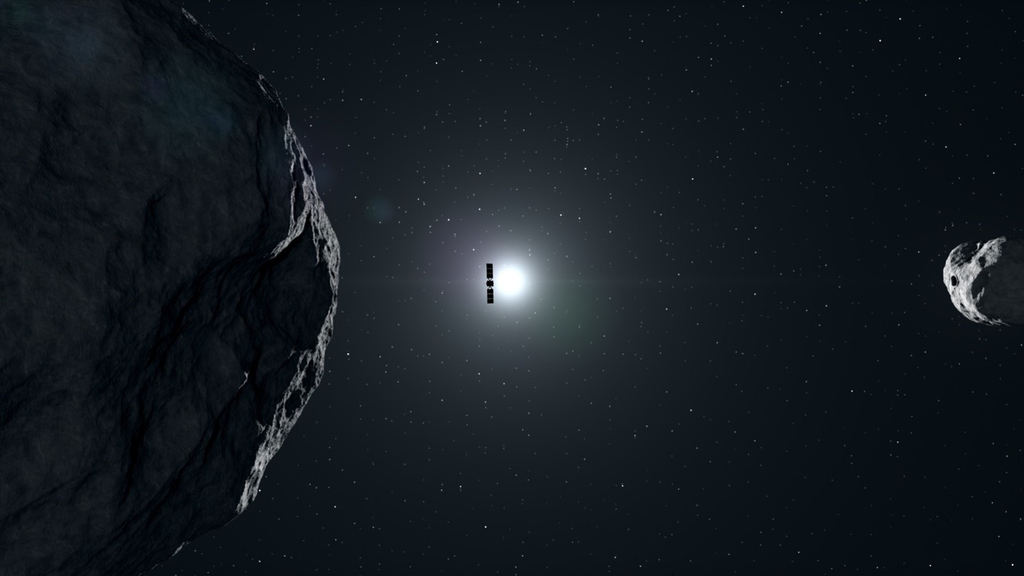
From arrival in November 2026 until December 2026, Hera will begin operations approximately 30 km away from the asteroid system to conduct physical and dynamical characterisations.
For Dimorphos, this means mapping its topography to determine how the DART impact warped its body. After footage of the overwhelming debris recoil, it is highly likely the crater grew to encompass the whole body, resulting in Dimorphos being completely reshaped. Hera expects to find a dramatically altered body, not just a simple crater.
Didymos has been found to be at the absolute limit of stability, spinning once every 2.26 hours. Studying the orbital and rotational dynamics of this system is vital to advancing our models of planetary evolution, especially given that 15% of all NEAs are binaries (Source: DLR).
Detailed Characterisation
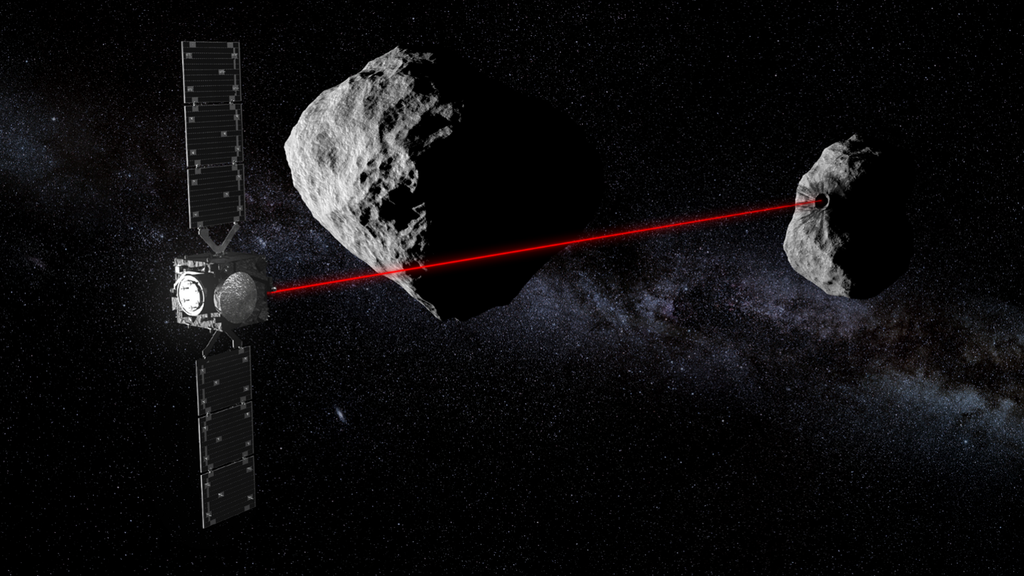
From December 2026 to early January 2027, Hera will fly as close as 10 km from the system’s barycentre. By determining the exact “wobble” period of Didymos, Hera will calculate accurate estimates of Dimorphos’ mass. This phase will be carried out by combining optical instruments and radio science experiments.
Later in the mission, once the CubeSats are deployed, Hera will be pushed to its limits and fly as close as 1 km to Dimorphos in an attempt to calculate the moonlet’s exact gravity and density by measuring how much Dimorphos tugs on Hera and capturing high resolution surface data. A very low density indicates it is internally highly porous, a classic indicator of a rubble pile.
A key instrument here is the Planetary Altimeter (PALT). This laser altimeter will track surface topography and support autonomous guidance, navigation, and control (GNC) as Hera approaches the high-risk environment of the asteroids
Direct Measurements by Juventas and Milani
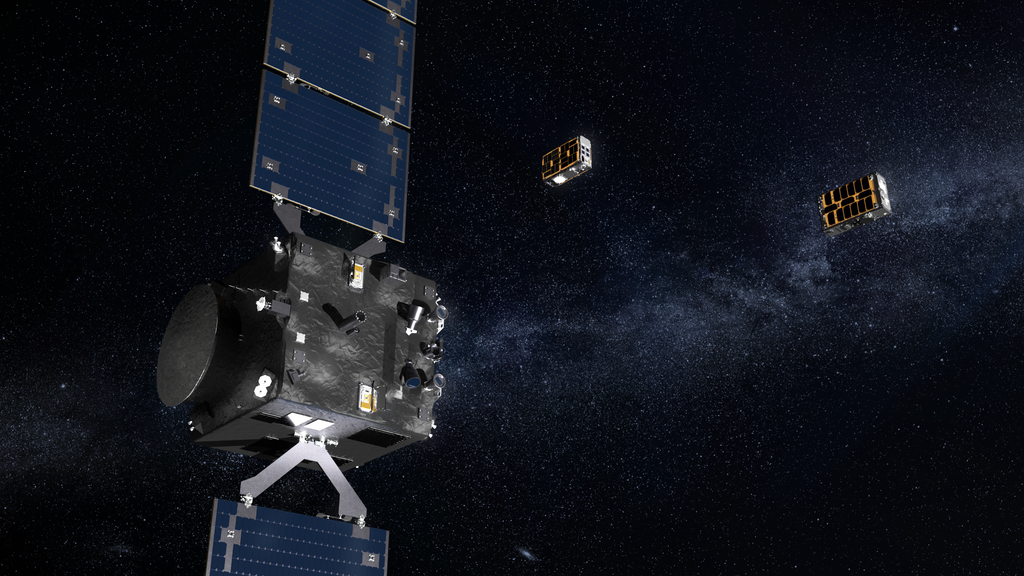
Following the indirect measurements, the mission will enter the Payload Deployment Phase (PDP) in early 2027. Hera will release its two companions, Milani and Juventas, operating up to just 4 km from the asteroid system. These two 6-unit sub-satellites are ESA’s first-ever deep-space CubeSats.
The primary goal is to gather high-resolution scientific data from vantage points that the large Hera mothership cannot reach safely. Since they are the size of a briefcase, they can perform close-proximity operations in extreme low-gravity conditions. While these are ESA’s first deep-space CubeSats, the methodology has strong heritage; in 2022, Italy’s LICIACube successfully recorded DART’s impact using a similar architecture.
Milani: Spectral and Dust Analysis
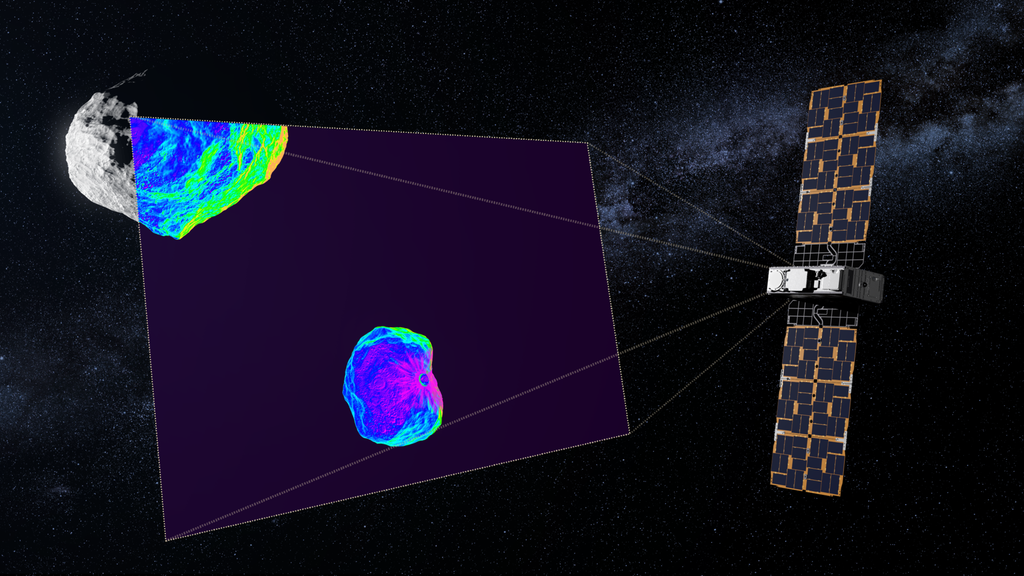
Developed by Tyvak in Italy, Milani is equipped with a navigation camera and the ASPECT hyperspectral imager. By analyzing sunlight reflected off both bodies across visible and infrared wavelengths, Milani aims to:
- Reveal compositional differences between the two asteroids.
- Shed light on how they interact with the space environment.
- Take magnetic readings for initial insights into interior structures.
- Perform a highly detailed census of the dust surrounding Dimorphos.
Juventas: Gravity and Internal Structure
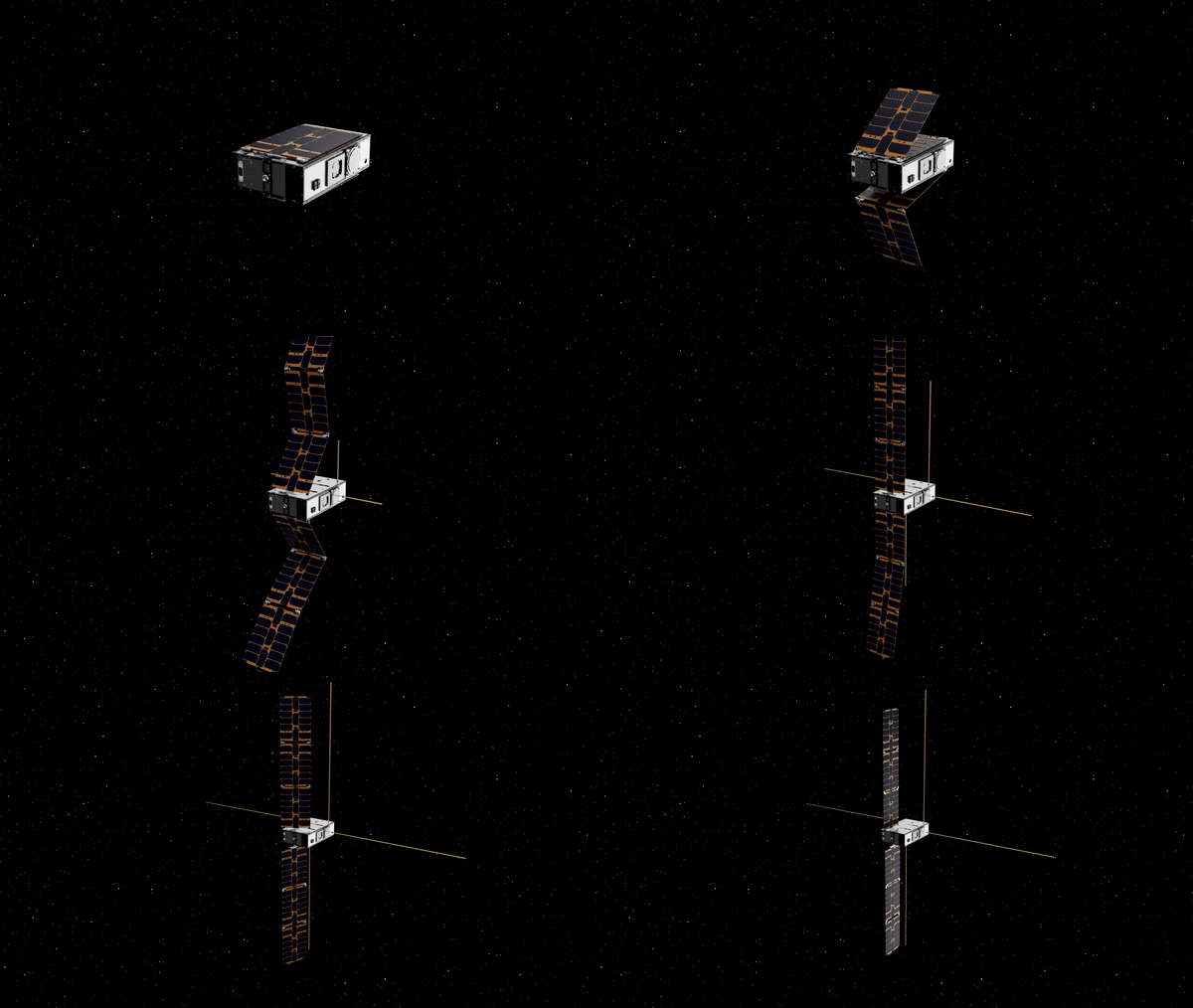
Developed by GomSpace, this CubeSat holds JuRa built by Anywaves, the smallest radar ever flown to space. Operating in sync with the mothership, Juventas is tasked with:
- Performing highly precise satellite-to-satellite radio science experiments.
- Carrying out a low-frequency radar survey of the moonlet’s interior.
- Effectively performing an “X-ray scan” to peer inside the body.
Settling the Great Debate
Juventas will provide the final, conclusive proof needed to settle the debate regarding Dimorphos’ interior. While Hera calculates mass from a distance, Juventas will physically map the moonlet’s internal architecture via the first-ever internal radar sounding of an asteroid.
As Juventas operates in close proximity, the JuRa instrument will transmit low-frequency radar waves capable of penetrating up to 100 meters into the 151 m wide body. If the radar waves bounce back cleanly with very few internal reflections, Dimorphos is a solid rock.
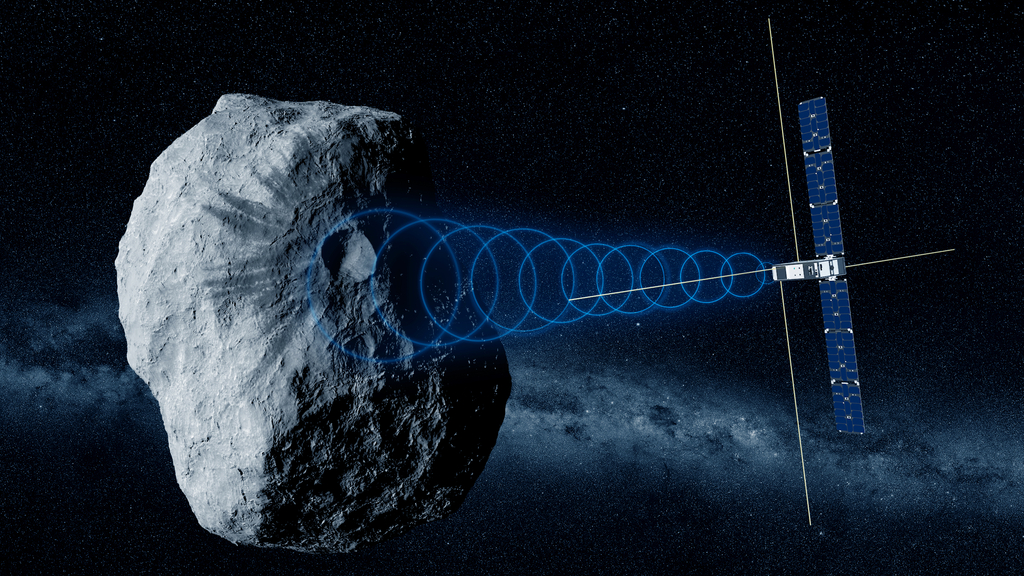
However, if the radar detects highly scattered signals, bouncing off thousands of internal voids and packed boulders, it will definitively prove the moonlet is a loose rubble pile. Confirming this structure allows scientists to see exactly how kinetic energy from the impact dissipated.
The Grand Finale: Landing
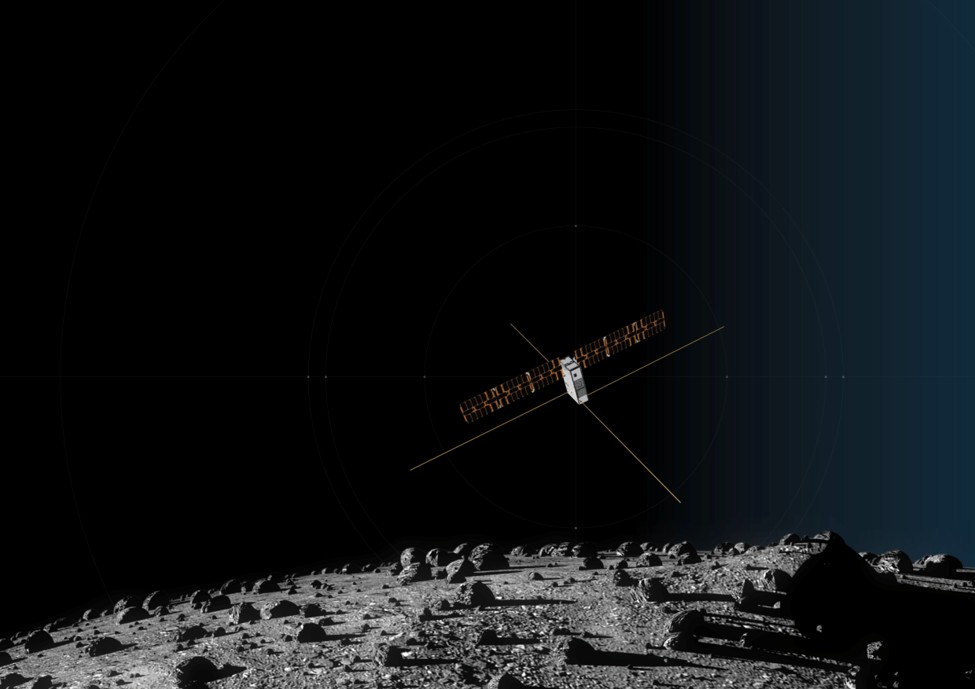
After April 2027, both CubeSats will conclude their orbital operations and attempt a touchdown on Dimorphos. Because the gravity is roughly a millionth of Earth’s, Milani and Juventas will undergo a ballistic, free-fall descent, bouncing chaotically across the surface before micro-gravity finally brings them to rest.
This uncontrolled tumble is not a design flaw; the landing itself is an instrument. By tracking the exact dynamics of how the CubeSats bounce, scientists can deduce the cohesion of the surface material which is crucial data if we ever need to land a heavy deflection device on an asteroid in the future.
If the landing is successful, Juventas will activate the GRASS gravimeter. Sitting directly on the moonlet, GRASS will directly measure the minuscule shifts in local surface gravity as Dimorphos orbits Didymos, capturing environmental dynamics impossible to measure from afar.
Anywaves: Keeping the ISL Alive
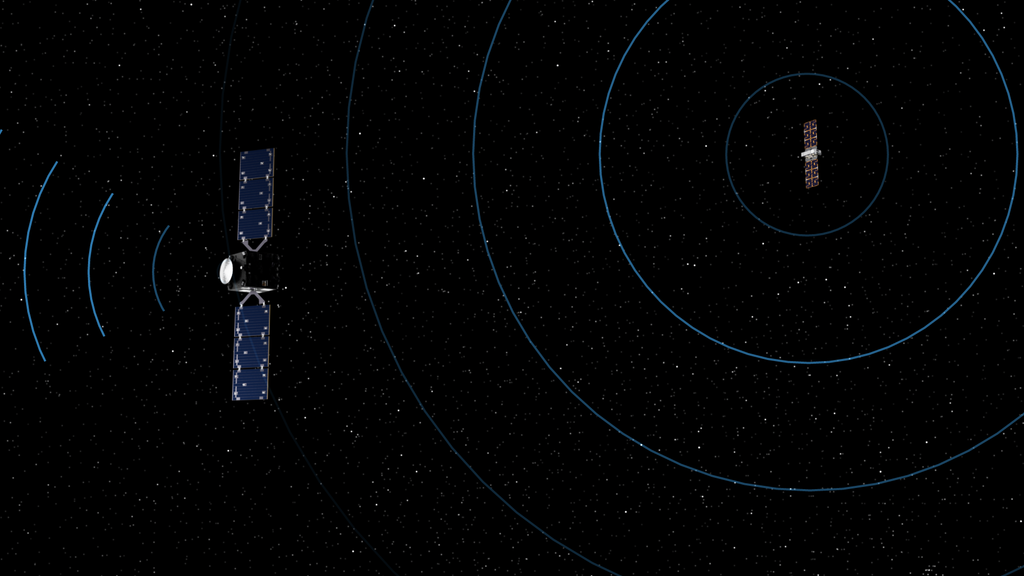
All three satellites will be undertaking different operations to fulfill a common aim, which requires constant, flawless communication via its Inter-Satellite Link (ISL). The CubeSats will operate up to 30 km away from Hera, representing a vast distance across which transceivers need to constantly relay data and track relative Doppler shifts.
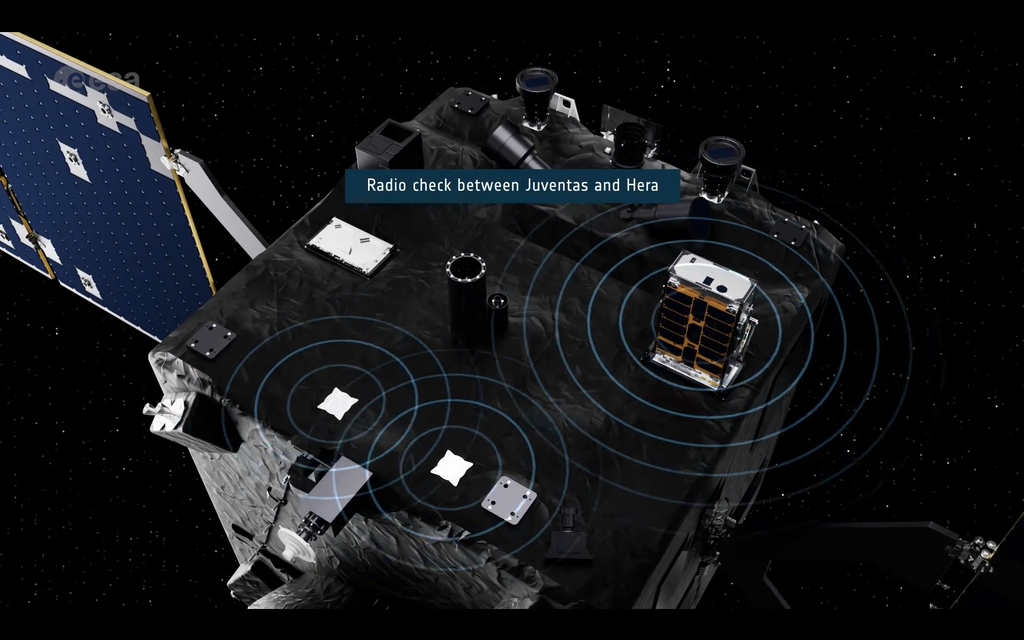
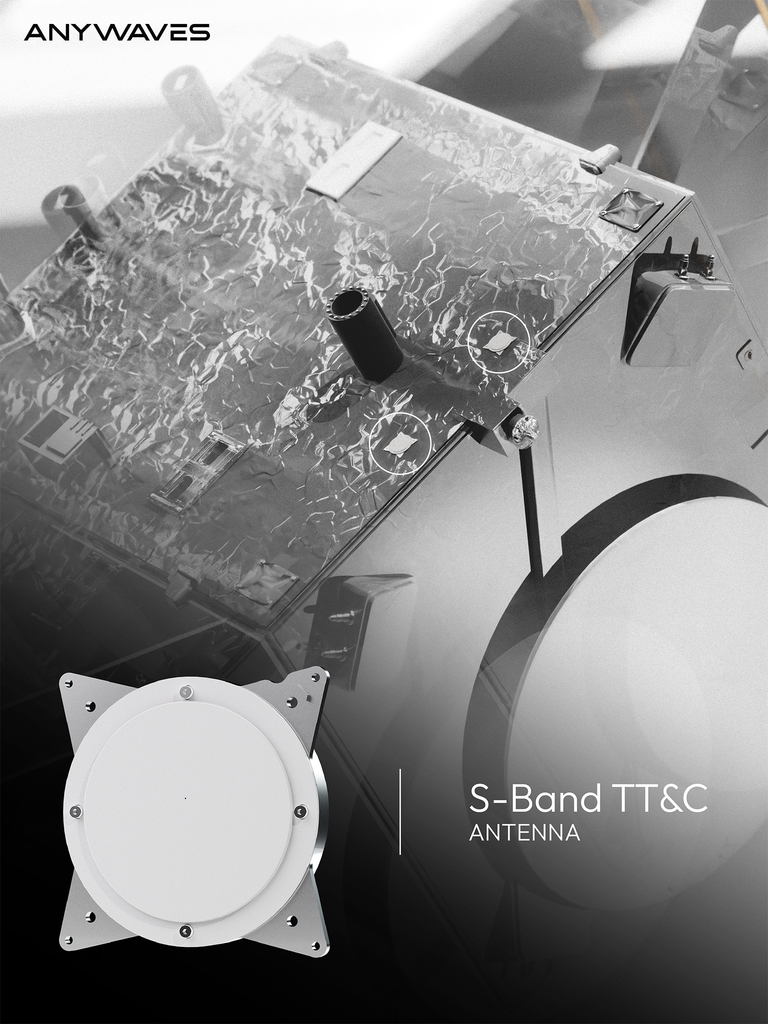
The Anywaves S-Band TT&C antenna has been integrated onto each spacecraft to allow the CubeSats to transmit collected science data back to Hera, which then relays it to Earth via its high-gain antenna.
The CubeSat landing phase represents the ultimate, high-stakes test for this hardware. As Juventas and Milani tumble across the asteroid, their physical orientation will be completely unpredictable. Yet, transmitting the data of these bounces is critical. This is where Anywaves’ antennas prove their absolute necessity.
If the CubeSats relied on highly directional antennas, the signal would be instantly lost during the tumble. However, since Anywaves designed these antennas to provide omnidirectional coverage, the orientation of the tumbling CubeSat simply does not matter. The Inter-Satellite Link remains unbroken.
Conclusion
Hera is a mission of historic firsts, but while Didymos grabs the headlines, the battered moonlet Dimorphos is the true star. Pinpointing its exact mass is the final piece of the planetary defense puzzle that DART began. Once solved, it will forever transform how future deflection missions are executed and the protection of our planet.
Ultimately, Hera’s finale is just the beginning. Every byte of data beamed across hundreds of millions of kilometres will serve as the blueprint for future planetary defense.
Anywaves is incredibly proud to make this possible. By providing the S-Band TT&C antennas alongside the JuRa radar antennas and electronics, we have built the vital data bridge between Hera and its CubeSats, delivering the first internal scan of an asteroid and securing this invaluable science before the data’s journey home.
Frequently Asked Questions About the Hera Mission
What is the main goal of the Hera mission?
Hera is Europe’s flagship planetary defense mission and the second half of a global collaboration with NASA. Following NASA’s DART impact in 2022, Hera is returning to the Didymos binary asteroid system to map the impacted moonlet, Dimorphos, calculate its exact mass, and determine exactly how efficiently DART transferred momentum to the asteroid.
Why is studying the internal structure of Dimorphos so important?
Scientists need to know if Dimorphos is a solid, monolithic rock or a loosely packed rubble pile held together by microgravity. Discovering the asteroid’s exact internal architecture allows engineers to calibrate their models for future planetary defense missions.
What is the JuRa instrument and how does it work?
JuRa (Juventas Radar) is the smallest low-frequency radar ever flown in space, carried onboard the shoebox-sized Juventas CubeSat. Operating at 50–70 MHz, JuRa is designed to penetrate up to 100 meters into Dimorphos, effectively giving the asteroid a deep 3D “X-ray scan.”
How do Hera and its CubeSats communicate so far from Earth?
Deep-space exploration relies on an Inter-Satellite Link (ISL). The Juventas and Milani CubeSats will operate up to 30 km away from Hera. To relay their heavy science data and receive critical flight commands, all three spacecraft are equipped with Anywaves S-Band TT&C antennas. These antennas link the CubeSats to Hera, which then beams the consolidated data millions of kilometers back to Earth.
What happens at the end of the mission?
The mission concludes with both Juventas and Milani attempting a free-fall landing on Dimorphos. As the moonlet’s gravity is roughly a millionth of Earth’s, they will bounce chaotically before coming to a rest and taking measurements. As for the Hera mothership, it won’t just shut down in mid-2027. Instead, it will transform into a deep-space “flying laboratory”, inviting European researchers to upload and test experimental software.

