The global space industry has experienced a monumental shift over the past decade. Expendable rockets are no longer the only way to reach orbit and international players have proven that by launching, landing and relaunching boosters. This is no longer just a science fiction dream but a highly viable economic model. By drastically lowering the cost per launch, these commercial leaders have created an undeniable economic urgency for the rest of the world.
Europe is actively stepping up to develop its own reusable launch technologies in order to maintain its strategic autonomy and competitive edge in space transportation. Fortunately, this kind of ambitious innovation doesn’t have to be an independent struggle, since the most powerful advancements always come from international collaboration. One mission at the forefront of this goal is CALLISTO, for which Anywaves was proudly selected in 2020 to provide the antennas.
Mission background
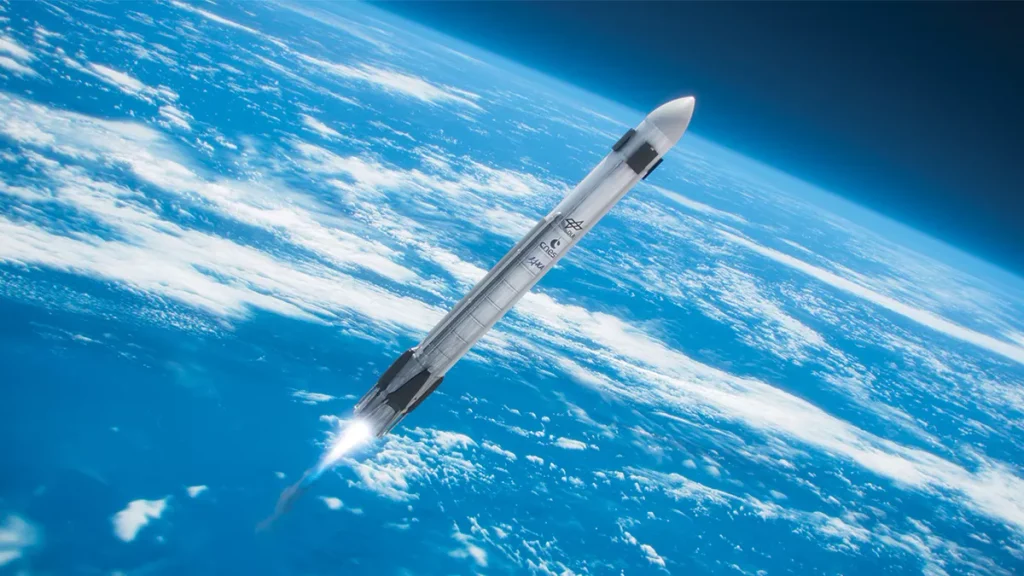
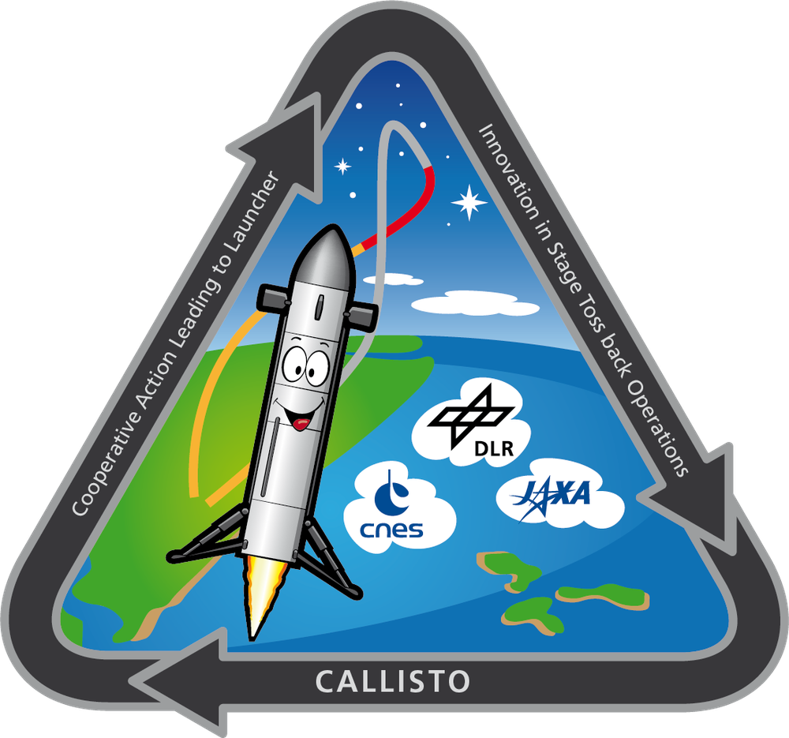
CALLISTO, Cooperative Action Leading to Launcher Innovation in Stage Toss-back Operations, is a flagship technology demonstrator. It is a joint and ambitious effort between the French space agency (CNES), the German Aerospace Center (DLR) and the Japanese Aerospace Exploration Agency (JAXA). In addition, this mission involves a large number of international industrial partners, among which Anywaves is proud to be a contributor.
This mission is a dedicated demonstrator rather than a future commercial vehicle. Its primary purpose is to execute a series of flight tests to physically master the complex return profile of a launch vehicle. Additionally, the mission is heavily focused on streamlining the requalification operations required between flights. By executing these rapid turnarounds in a real-world environment, engineers will be able to accurately estimate the true maintenance and operational costs of future European launchers equipped with reusable first stages.
Standing 13 m tall and spanning one metre in diameter, CALLISTO is a reusable vertical take-off and vertical landing (VTVL) powered by a cryogenic engine that burns liquid hydrogen and liquid oxygen supplied by JAXA. Generating roughly 40 kN of thrust, this rocket is designed to ascend to an altitude of about 20 km to perform a highly complex series of manoeuvres and return safely to a landing pad on Earth. It is a bold leap forward for European spaceflight and Anywaves is glad to be part of the journey.
The Timeline of the Mission
The origins of this ambitious project trace back to late 2015 when CNES first kicked off the concept in-house. Recognising the massive scope of the challenge and the need for international expertise, both JAXA and DLR officially joined the partnership in 2017.
As with any aerospace endeavor, the path to the launchpad has required significant patience and adaptation. According to the original 2018 timetable, the first flight was actually scheduled for late 2020, with the entire testing campaign wrapping up by the end of 2021. However, the timeline experienced several necessary shifts over the years to accommodate the sheer complexity of the engineering required. The target launch moved to 2022, and then to 2026 before recent project updates confirmed that the inaugural flight test will officially take place in 2027.
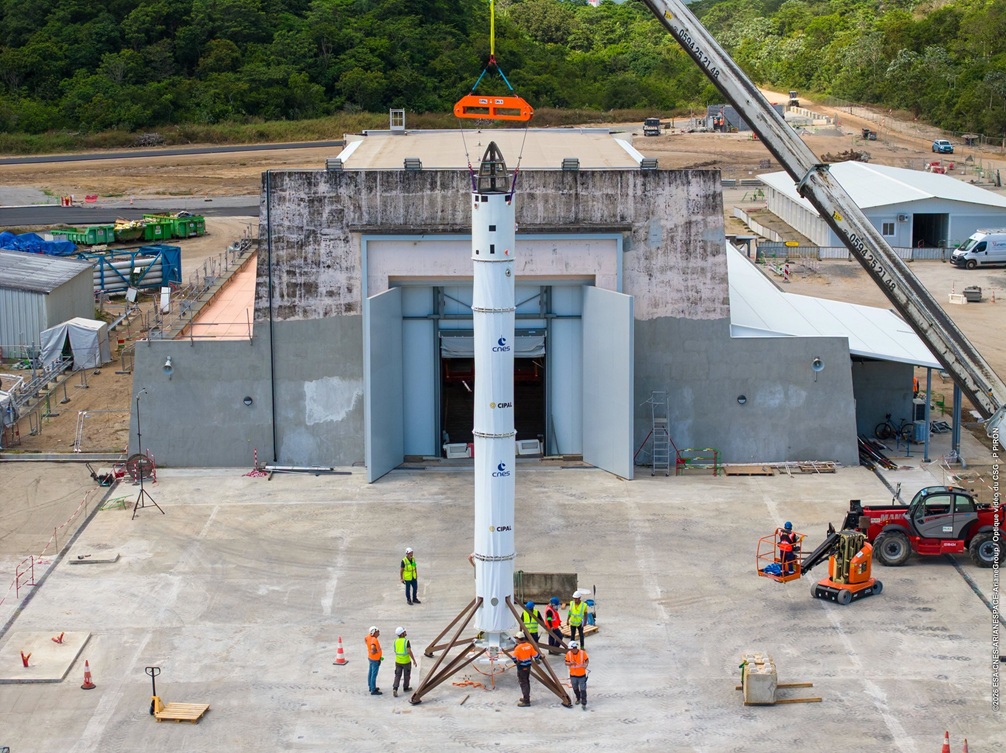
Rather than building the entire rocket in one place, the manufacturing and integration of CALLISTO is a distributed international effort. The vehicle is currently split into specific sections across the partner nations. In Japan, JAXA is responsible for assembling the core propulsion block. Following the successful mid-2026 flight tests of their own RV-X rocket (a technological pathfinder) JAXA is now preparing the CALLISTO propulsion section for a critical hot-fire engine test campaign at the Noshiro Test Center.
Meanwhile, European teams are handling the upper sections of the vehicle. DLR manufactured and tested the carbon-fibre nose cone and landing legs. In late 2026, this nose cone was transferred to CNES in France where its being actively integrated into the top block of the rocket. Final assembly of the complete flight-ready vehicle combining the Japanese propulsion section and the European top block will take place directly at the launch site in French Guiana.
Currently, in late 2026, the ground qualification testing campaign is already underway at the Guiana Space Centre, at the former Diamant launch facility (now designated as ELM-Diamant). This is a site rich with European space history since the 1970s and is now being repurposed for a new era of reusable technology, aligning with the mission’s overall goal. It will also later be used to host European micro-launchers such as Isar Aerospace, PLD Space and Latitude.
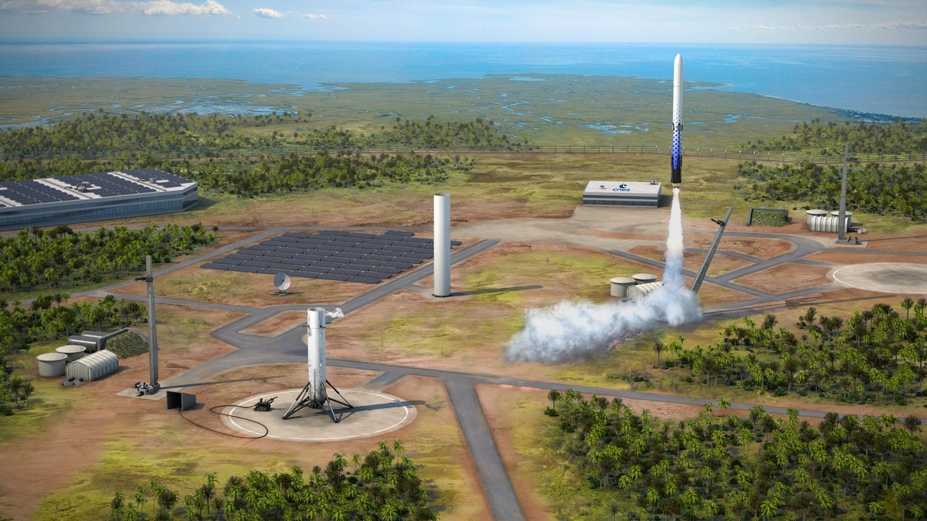
Before the final reusable rocket is brought onto the launchpad, teams on the ground are using a full-scale mockup to validate the physical ground infrastructure and rehearse turnaround operations. This mockup is equipped with Anywaves flight-configuration antennas to rigorously test vehicle-to-ground telemetry links before the real hardware even arrives. Once these ground systems are fully qualified, the actual flight vehicle will be assembled for its highly anticipated series of 10 flights, from hop tests to high energy flights, in 2027.
Brief Mission Timeline
- Late 2015: The project was officially kicked off in-house at CNES.
- 2017: Partners JAXA and DLR officially joined the project.
- Late 2019: The preliminary design phase came to an end.
- Late 2024: The detailed design phase concluded.
- 2025: Full vehicle integration was originally planned to take place in Japan during this year.
- Mid-2026: JAXA flew its RV-X vehicle. This rocket served as a Japanese technology pathfinder for CALLISTO.
- August 2026: Nammo delivered its hydrogen peroxide propulsion system to CNES. This system is intended for the reaction control system of the vehicle.
- September 2026: DLR completed the final testing of the nose cone. This hardware was then set to be transferred to France for final integration.
- October 2026: Ground qualification testing officially began for the CALLISTO reusable rocket demonstrator.
- 2027: The first test flights are scheduled to take place.
The Future of European Launchers
CALLISTO is a pathfinder vehicle, it is not designed to deliver commercial satellites into orbit. Its only payload is knowledge and flight data, which once gathered here will directly feed into parallel European reusable projects. This includes ESA’s Themis program, which is preparing for its own hop tests in 2027, and commercial efforts like MaiaSpace. CALLISTO serves as a crucial step toward the foundational architecture of Ariane Next and Europe’s next generation of heavy-lift rockets.
To build a viable and safe European reusable rocket, engineers need:
- hard telemetry from real-world conditions
- exact aerodynamic behaviours of a vehicle during manoeuvres and descent.
- complex flight algorithms that reignite the engine to execute a controlled and propulsive vertical landing
However, mastering the flight profile is only half the battle. Reusability is ultimately an economic and operational challenge. The project is seeking to prove that a vehicle can be maintained, repaired and turned around rapidly enough to perform multiple flights within a matter of months.
How quickly can a rocket be recovered, inspected, refurbished and placed back on the launchpad for its next mission? The project currently plans for a series of ten test flights. The operational lessons learned from these flights will directly inform the financial models of future European launchers.
Anywaves Launcher Antennas
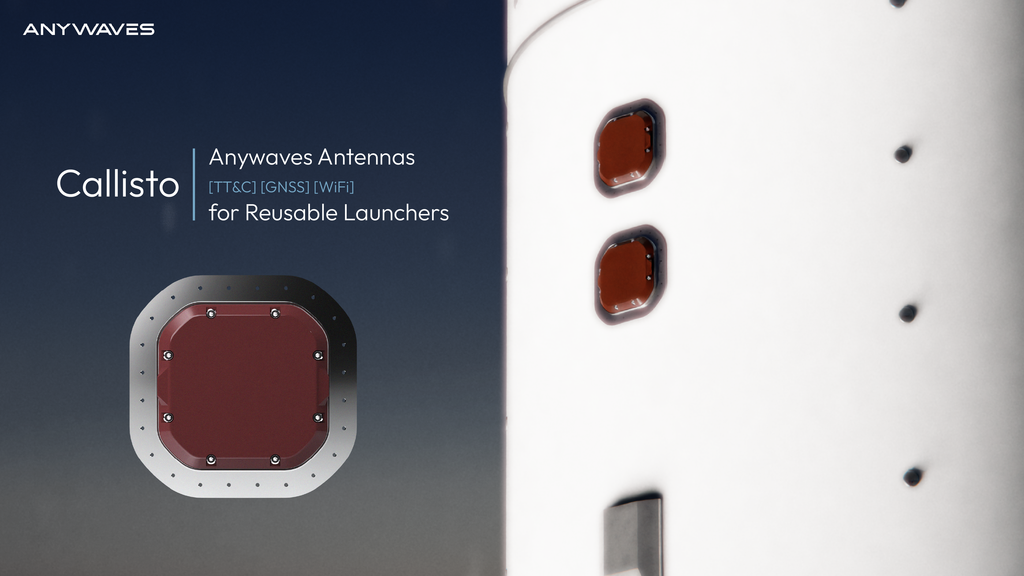
A state-of-the-art reusable rocket requires state-of-the-art communications. If ground control loses contact with a rapidly descending vehicle, the entire mission is compromised. Anywaves is providing the essential antenna technologies that will keep CALLISTO connected from the moment of liftoff to the final touchdown. We have successfully delivered the flight-ready hardware and these units are already integrated and currently undergoing rigorous ground validation on the mockup in Guiana.
S-Band Antennas
General Purpose
The S-Band antenna serves as the primary communications lifeline of a mission. Operating in the 2.025 to 2.29 GHz frequency range, it handles telemetry, tracking and command. This critical connection allows automated flight software to communicate continuously with mission control, keeping ground operators fully aware of the trajectory and vehicle system status.
Engineered for CALLISTO
For the CALLISTO vehicle, Anywaves developed a TRL 8 S-Band launcher unit providing a signal gain exceeding 6.0 dBi at boresight, while remaining incredibly compact at just 145 by 145 by 30 mm. Since this antenna is mounted directly on the exterior of the rocket frame, we integrated a bespoke thermal shield which absorbs and deflects intense aero-thermal heat flux during launch and atmospheric reentry while remaining entirely transparent to radio frequencies, ensuring full duplex transmission without signal degradation.
GNSS Antennas
General Purpose
Landing a 13-metre rocket on a designated pad requires pinpoint accuracy. GNSS antennas capture signals from global navigation satellite systems (such as GPS and Galileo) to feed ultra-precise location, velocity and timing data to the onboard flight computers. This exact precision is what allows the landing algorithms to maintain three-axis control and guide the vehicle safely home.
Engineered for CALLISTO
Our GNSS all-bands launcher antenna ensures there is absolutely no signal blackout risk during the high-dynamic phases of ascent and boostback. Measuring 150 by 150 by 30 mm, this TRL 8 unit features a highly stable phase center and circular polarization to maintain consistent signal quality across the full visible sky. Like the S-Band, it is equipped with our custom heat shield to survive liftoff and descent conditions while mounted on the rocket exterior.
WiFi Antennas
General Purpose
Reusability relies heavily on rapid and efficient turnaround times on the launchpad. WiFi antennas are designed for onboard to ground communication while the vehicle is stationary. They enable high-speed wireless data transfer, allowing engineers to offload massive amounts of recorded flight data and run comprehensive system diagnostics very quickly.
Engineered for CALLISTO
To support CALLISTO’s goal of rapid operational turnarounds, our custom-made WiFi antenna eliminates the need to manually connect physical cables to the rocket body. Mounted externally and built to endure the elements, it dramatically streamlines the post-flight inspection and data recovery process, directly supporting the mission objective to prove that a vehicle can be maintained and turned around efficiently.
Anywaves Testing for Reusability
Designing space equipment is always an engineering challenge. However, building hardware for a single-use rocket is fundamentally different from building hardware for a vehicle that will launch and land repeatedly.
CALLISTO is designed for a demanding lifetime of up to 10 relaunches, the traditional method of verifying that an antenna can survive a single launch profile was not sufficient, so our engineering team had to completely rewrite testing methods. Instead of standard qualification tests, we had to subject our products to more intense repetitive fatigue testing to ensure they perform flawlessly on the tenth flight without any structural degradation.
S-Band Testing
Maintaining the critical telemetry link during an engine ignition requires extreme durability. Liftoff thrust alone can create high g-loads that exceed 4 to 5 g. Adding abruptly executed staging events generates massive shock waves that can severely damage unreinforced equipment. We exposed the S-Band antennas to these intense acoustic shocks and continuous extreme vibrations in repetitive cycles. This replicated a full lifetime of engine ignitions and aerodynamic buffeting to guarantee that the primary communications lifeline would never break during its operational lifespan.
GNSS Testing
Precision navigation hardware is highly sensitive to environmental extremes. Usually, our antennas are qualified to handle standard thermal ranges between -120°C and +120°C. For the CALLISTO GNSS antennas, we quickly realised that traditional thermal tests at these limits are insufficient for a reusable vehicle. We subjected the GNSS units to thermal cycling of -120°C to +360°C instead, in order to represent the extreme temperature that rocket exteriors experience. This repetitive testing verified that the antenna’s highly stable phase center would not warp or degrade, ensuring perfect trajectory data after each flight.
WiFi Testing
While the WiFi antennas primarily operate when the vehicle is sitting on the pad or the landing zone, they still must survive the whole flight profile to be useful upon touchdown. To qualify them for 10 relaunches, we tested the WiFi units against combined fatigue profiles. This rigorous approach ensured that the internal electronics could endure the repetitive 4 to 5 g mechanical stresses of launch alongside the thermal shocks of reentry, guaranteeing that the high-speed data transfer link is immediately operational the moment the rocket is safely back on the ground.
Conclusion
The global space industry has reached a point where reusability is no longer just an experiment but the fundamental baseline for the future of space transportation. For Europe to secure autonomous and cost-effective access to orbit, mastering the complex operations of launching, landing and rapidly relaunching vehicles is absolutely essential. The ground testing currently underway at the Guiana Space Centre proves that this vision is rapidly becoming a physical reality. The hardware is built, the launchpad infrastructure is being validated and the countdown to the 2027 flight test has effectively begun.
For Anywaves, the mission represents a milestone of our own. By engineering the complete antenna suite for this demonstrator, we have pushed our technology to new limits. We have successfully adapted our equipment to survive extreme thermal shocks, aerodynamic loads and the repetitive mechanical stresses required for a rocket designed to fly up to a dozen times.
CALLISTO is a big source of pride; we are honoured to see our bespoke antennas and advanced heat shields tested on such a groundbreaking vehicle. This collaboration allows us to remain at the edge of state-of-the-art space communications while contributing to the next generation of spaceflight. We are deeply proud to actively equip one of the very first reusable launcher missions and incredibly excited for the historic flight tests that lie ahead.
Are you designing a mission that needs flight-proven RF payload electronics or antennas?

