Only 48 hours after launch, LEONAV-1 had already reached a defining moment: its navigation payload was active, and the mission team had received the first signal at the ground station in Al Ain.
Launched on July 7, 2026, LEONAV-1 is the United Arab Emirates’ first satellite dedicated to satellite navigation technologies. This compact 12U CubeSat is not intended to deliver an operational navigation service on its own. It is a technology demonstrator—and the first in-orbit step toward a future Emirati Low Earth Orbit Positioning, Navigation and Timing architecture.
Developed for the National Space Science and Technology Centre (NSSTC) at United Arab Emirates University, with the support and funding of the UAE Space Agency, LEONAV-1 brings together Emirati leadership and French space expertise. Toulouse-based small-satellite manufacturer U-Space designed, manufactured, tested and delivered the spacecraft, integrating the payload in just 12 months. Anywaves supplied two antenna families that support the satellite’s communications and onboard navigation: S-Band TT&C and ceramic GNSS E1/L1 antennas.
The mission has now successfully completed its first operational phase. Its navigation payload has been validated, and navigation signals transmitted from Low Earth Orbit have been received and processed—turning a small spacecraft into a major milestone for the UAE’s next-generation PNT capabilities.
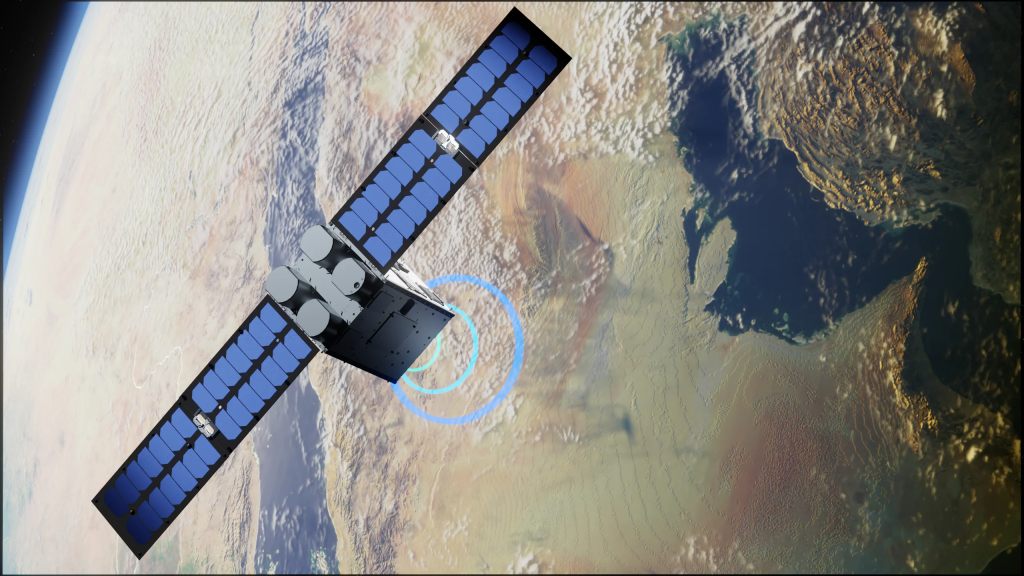
LEONAV-1 at a Glance
| Mission Parameter | Detail |
|---|---|
| Mission name | LEONAV-1, also described as LEONAV Stage-1 |
| Mission type | LEO-PNT technology demonstrator |
| National milestone | First Emirati satellite dedicated to satellite navigation technologies |
| Operator and mission lead | National Space Science and Technology Centre (NSSTC), United Arab Emirates University |
| Support and funding | UAE Space Agency |
| Spacecraft designer and manufacturer | U-Space, France |
| Spacecraft class | 12U CubeSat |
| Launch date | July 7, 2026 |
| Launch mission | SpaceX Transporter-17 rideshare aboard Falcon 9 |
| Launch site | Vandenberg Space Force Base, California, United States |
| Orbit | Sun-synchronous Low Earth Orbit, approximately 590 km altitude |
| Catalogue identifiers | NORAD 69937; COSPAR 2026-156BW |
| Payload objective | Transmit and validate GNSS-like signals in L5/E5 and S-Band; assess Orbit Determination and Time Synchronization software |
| First operations | LEOP completed in 36 hours; payload activated and first mission signal received in Al Ain within 48 hours |
| Anywaves equipment onboard | S-Band TT&C antenna and ceramic GNSS E1/L1 antenna |
A First Step Toward a UAE LEO-PNT Capability
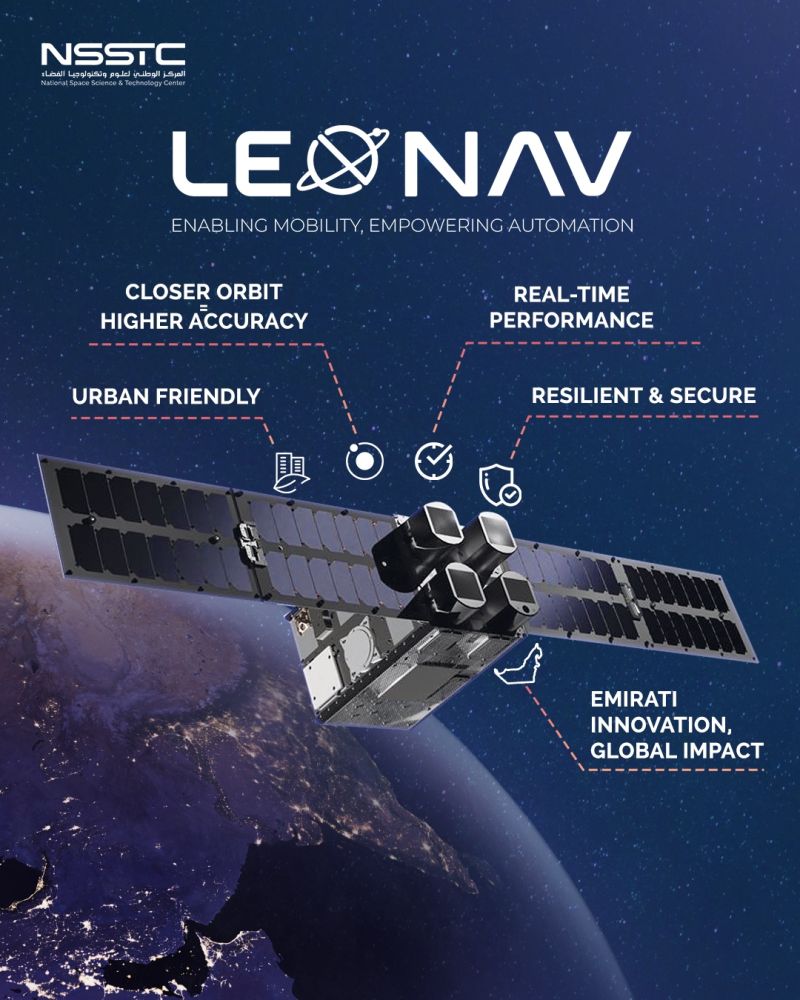
Positioning, Navigation and Timing services are part of the invisible infrastructure of modern life. They support aviation, transport, autonomous systems, telecommunications, energy networks, financial systems and emergency services. Today, most global satellite navigation signals come from constellations in Medium Earth Orbit, roughly 20,000 kilometres above the Earth.
LEO-PNT explores a complementary layer much closer to the planet. Signals transmitted from Low Earth Orbit travel a far shorter distance to users than signals originating in MEO. This can provide higher received power and faster-changing satellite geometry, while adding orbital and frequency diversity to existing GNSS services. In future hybrid architectures, these characteristics could improve availability, accuracy and resilience in challenging environments, including dense cities and areas affected by interference.
LEONAV-1 is designed to test this potential in orbit. According to United Arab Emirates University, the mission aims to:
- Generate and transmit GNSS-like navigation signals in the L5/E5 and S frequency bands without interfering with existing navigation systems.
- Verify the end-to-end transmission and reception of these signals through ground stations.
- Assess onboard Orbit Determination and Time Synchronization (ODTS) software.
- Characterise navigation-signal stability and payload performance in the real LEO environment.
- Build the technical knowledge and operational expertise required for possible future LEO-PNT satellites and services.
This makes LEONAV-1 a precursor, not a standalone replacement for GPS, Galileo, BeiDou or GLONASS. Its role is to reduce technical uncertainty, collect in-orbit evidence and validate the building blocks of a future multi-layer navigation system.
From Al Ain to Orbit: The Mission Partners
LEONAV-1 is led and operated by the National Space Science and Technology Centre at United Arab Emirates University in Al Ain. The project is supported and funded by the UAE Space Agency as part of the country’s effort to strengthen national capabilities in space science, engineering and satellite operations.
The spacecraft itself was developed by U-Space in Toulouse. Building on the company’s previous LEO-PNT work with the PANDORE mission, U-Space delivered a mission tailored to NSSTC’s requirements. The company reports that the satellite—including payload integration—was designed, manufactured and tested in only 12 months. LEONAV-1 is also U-Space’s first contract for a customer outside Europe and its second international contract.
For Anywaves, the mission extends an established collaboration with U-Space and adds another LEO-PNT spacecraft to our flight heritage. The project is a clear example of focused international cooperation: Emirati engineers and researchers lead the mission and on-orbit operations, while specialist French suppliers contribute platform and RF technologies and enable hands-on knowledge transfer.
LEONAV-1 Technical Details: A 12U CubeSat Built for In-Orbit Demonstration
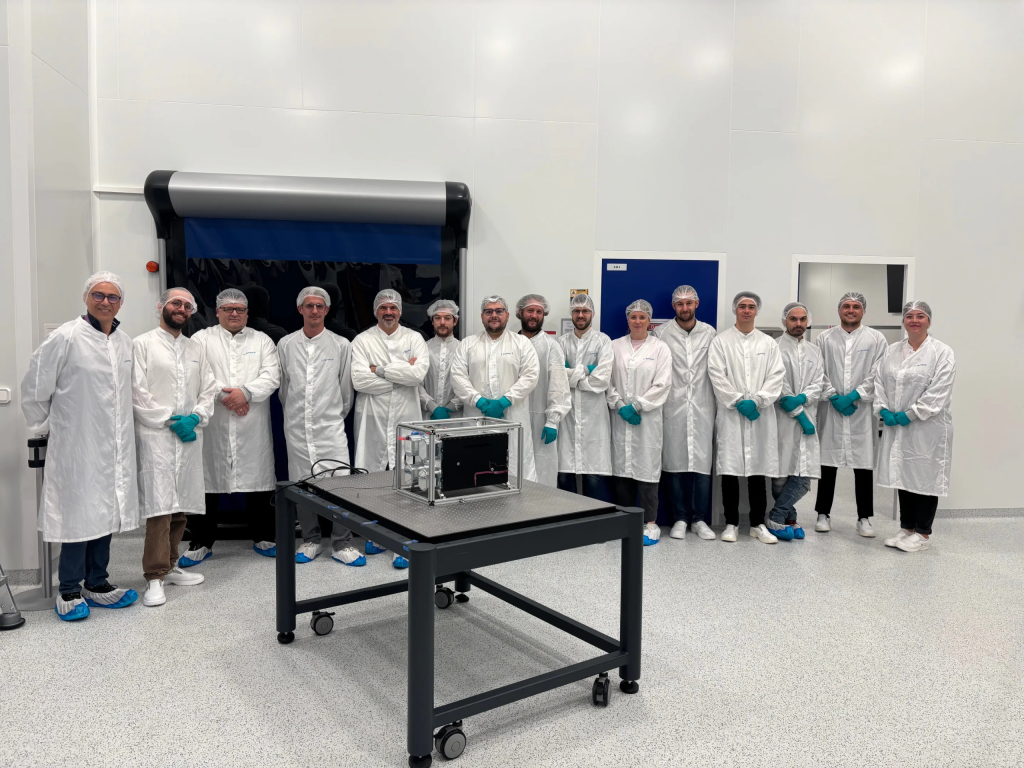
U-Space identifies LEONAV-1 as a 12U CubeSat. A 12U platform provides twelve standard CubeSat units of internal capacity and typically belongs to the approximately 20 × 20 × 30 cm spacecraft class before mission-specific external elements and deployables are considered. The exact flight dimensions, mass, power budget and payload volume of LEONAV-1 have not been publicly disclosed.
For context, the CubeSat Design Specification Rev. 14.1 covers spacecraft up to 12U and lists 24 kg as the typical maximum mass for a standard 12U configuration, while noting that actual limits depend on the dispenser and launch provider. These are format-level reference values, not confirmed LEONAV-1 flight specifications.
Within this compact platform, the spacecraft must accommodate:
- The experimental navigation payload for L5/E5- and S-Band signal generation.
- Onboard ODTS processing to estimate the satellite’s orbit and maintain the timing knowledge required for PNT experiments.
- Attitude determination and control, electrical power, command and data handling, thermal control and flight software.
- TT&C communications for commanding the spacecraft and returning health telemetry.
- A higher-rate mission-data link for transferring payload results to the ground.
- GNSS reception for spacecraft navigation, orbit knowledge and timing support.
Public orbital tracking data identifies LEONAV-1 as NORAD object 69937 in a near-polar, Sun-synchronous orbit at approximately 590 km altitude, with an inclination close to 97.8 degrees and an orbital period of about 96 minutes. At this altitude, the spacecraft circles the Earth almost 15 times per day. Orbital parameters evolve over time and should be understood as current tracking data rather than fixed mission requirements.
Launch and Early Operations: Key Dates
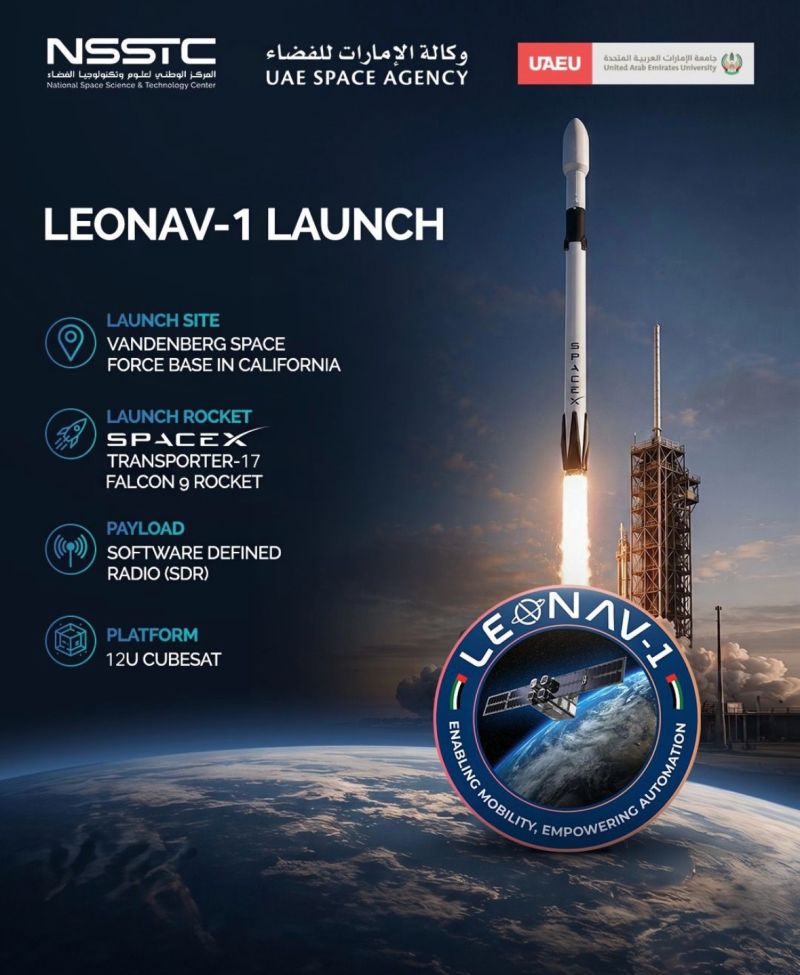
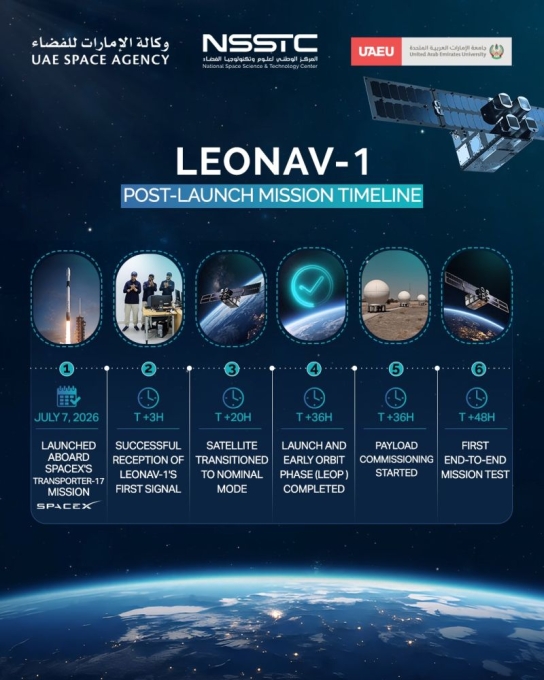
July 7, 2026 — Launch on Transporter-17
LEONAV-1 launched aboard a SpaceX Falcon 9 from Vandenberg Space Force Base in California as part of the Transporter-17 rideshare mission. Transporter-17 carried 81 payloads to a Sun-synchronous Low Earth Orbit, providing the deployment route for a diverse group of CubeSats, microsatellites and hosted missions.
Within 36 Hours — LEOP Completed
The NSSTC mission team completed the Launch and Early Orbit Phase in 36 hours. LEOP is one of the most critical periods in any mission: operators establish communications, confirm spacecraft health, stabilise attitude, verify power generation and check the readiness of the principal subsystems.
Within 48 Hours — Payload Activated and First Signal Received
Within the first 48 hours, the navigation payload was activated and the first mission signal was received at NSSTC’s ground station in Al Ain. This closed the initial space-to-ground loop and marked the beginning of LEONAV-1’s operational life.
August 3, 2026 — First Operational Phase Confirmed
NSSTC announced that LEONAV-1 had successfully completed its first operational phase. The centre confirmed the validation of the navigation payload and the reception and processing of navigation signals transmitted from LEO. The result demonstrated the mission’s transition from spacecraft commissioning to the achievement of its core technical objectives.
Two Anywaves Antenna Technologies Onboard LEONAV-1
LEONAV-1 depends on several RF links with distinct and complementary roles. Anywaves supplied the antenna hardware for two of them: spacecraft TT&C and onboard GNSS reception. Together, these antennas connect the 12U spacecraft to its operators, its ground segment and the navigation constellations above it.
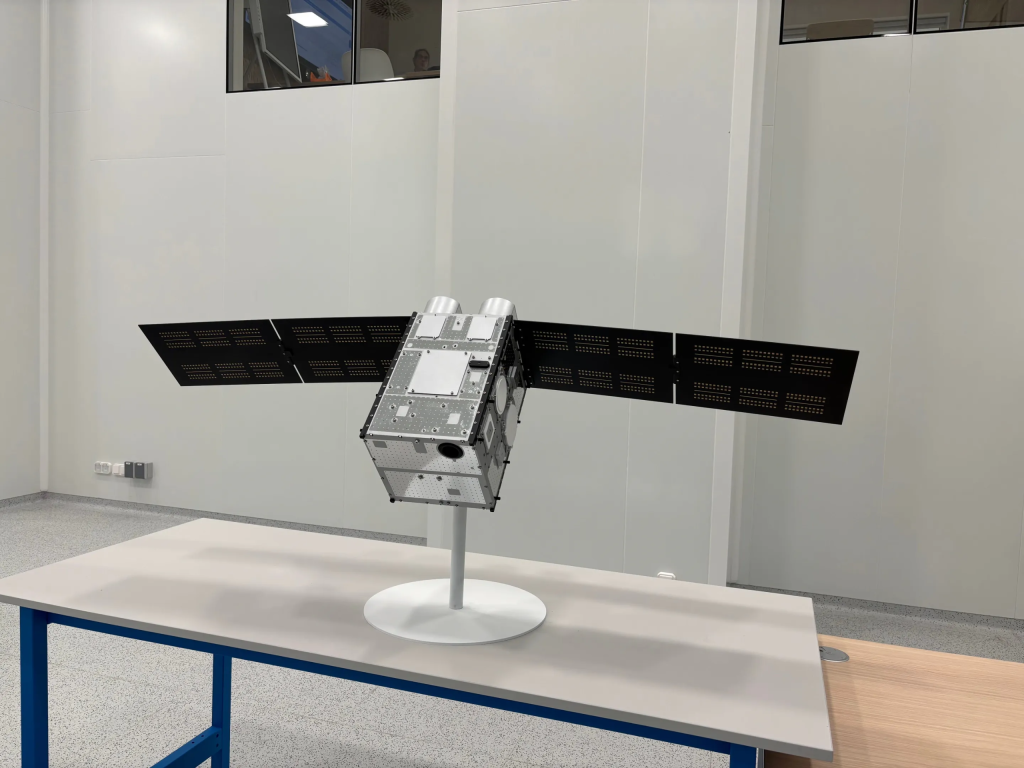
S-Band TT&C Antenna: Maintaining the Command and Telemetry Link
The S-Band antenna supports Telemetry, Tracking and Control—the operational link used to command the spacecraft and retrieve housekeeping information. During LEOP, when attitude knowledge may still be limited and rapid access to spacecraft health data is essential, reliable TT&C coverage is particularly critical.
Anywaves’ flight-proven S-Band TT&C antenna operates from 2.025 to 2.29 GHz and combines circular polarisation with wide hemispherical coverage. Its compact footprint is suited to CubeSat-class panels. On LEONAV-1, this antenna contributes to the link between the satellite and the NSSTC operations team, supporting commissioning and routine spacecraft control.
Ceramic GNSS E1/L1 Antenna: Supporting Orbit and Time Knowledge
The GNSS E1/L1 antenna receives signals from established navigation constellations to support the spacecraft’s own position and time knowledge. This function is especially relevant to a LEO-PNT demonstrator: evaluating a navigation signal generated onboard requires precise knowledge of the transmitting satellite’s orbit and clock.
Anywaves’ ceramic GNSS E1/L1 antenna covers the GPS L1 and Galileo E1 band around 1,575.42 MHz. Its right-hand circular polarisation, hemispherical coverage and stable phase-centre behaviour support onboard orbit determination and timing. The compact antenna fits within a 1U panel footprint, making it compatible with the constrained external geometry of LEONAV-1.
Each antenna therefore answers a different mission need:
| Anywaves antenna | Function on LEONAV-1 | Why it matters |
|---|---|---|
| S-Band TT&C | Telecommand, spacecraft telemetry and tracking | Keeps the satellite reachable through commissioning and routine operations |
| Ceramic GNSS E1/L1 | Reception of GPS L1 and Galileo E1 signals | Supports onboard position, orbit and timing knowledge for the PNT experiment |
This multi-band architecture illustrates an important systems principle: the navigation payload cannot be assessed in isolation. The spacecraft must be commanded reliably, know where and when it is transmitting, and return enough data for engineers to evaluate the experiment on the ground.
Why LEONAV-1 Matters for Next-Generation Navigation
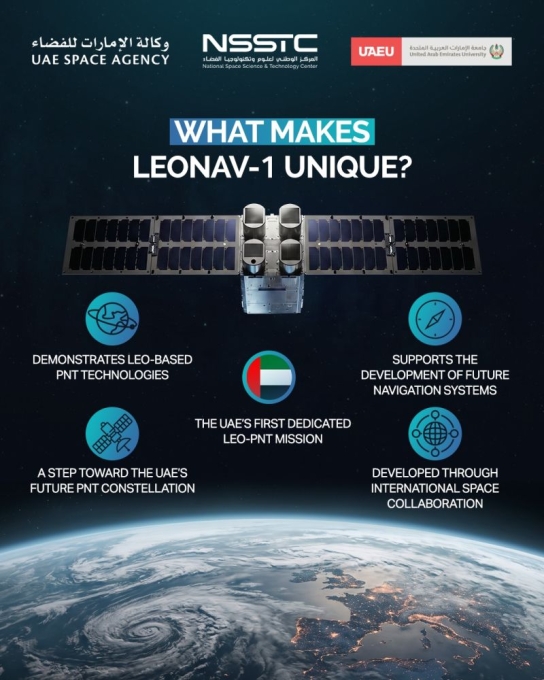
LEONAV-1 gives the UAE a practical in-orbit laboratory for LEO-PNT. By operating a real navigation payload rather than relying only on modelling or ground testing, NSSTC can observe the combined effects of orbital dynamics, Doppler, timing behaviour, radio propagation, spacecraft attitude and ground-segment performance.
The first operational results are significant because they validate the complete chain: the spacecraft survived launch, established communications, activated its payload, transmitted from LEO and enabled the reception and processing of navigation signals on the ground.
The knowledge generated by the mission could ultimately support research and applications in intelligent transportation, aviation and autonomous mobility. More broadly, it helps the UAE develop national skills in payload engineering, satellite navigation, mission operations and performance assessment—capabilities that will be essential if the LEONAV programme progresses from a single demonstrator toward a larger architecture.
What Comes Next for LEONAV-1?
With commissioning and the first operational phase complete, the focus now shifts from initial verification to sustained experimentation and performance characterisation. NSSTC has stated that it will continue the mission’s operational and scientific programme.
The next steps are expected to include:
- Repeated transmission, reception and processing of navigation signals over multiple passes and geometries.
- Detailed characterisation of payload performance and signal stability in orbit.
- Assessment and refinement of onboard ODTS performance.
- Correlation of satellite telemetry, orbital data and ground-station measurements.
- Evaluation of compatibility with existing GNSS infrastructure and interference constraints.
- Collection of engineering evidence to guide future LEONAV satellites and a possible LEO-PNT constellation architecture.
- Continued training and hands-on operational experience for Emirati engineers and researchers.
LEONAV-1’s long-term value will come from this accumulated dataset. A demonstrator answers its most important questions through repetition: measuring performance under changing orbital geometry, thermal conditions and link configurations, then translating those results into better system requirements for the next generation.
Conclusion: A Compact Satellite, a Strategic First
LEONAV-1 shows how a 12U CubeSat can serve as a focused national technology demonstrator. Less than two days after launch, the satellite had completed LEOP, activated its payload and delivered its first signal to Al Ain. Within its first month in orbit, the mission had validated the payload and processed navigation signals transmitted from LEO.
For the UAE, this is the beginning of a new chapter in sovereign navigation research and operational expertise. For U-Space, it demonstrates the ability to deliver an integrated international mission on a demanding 12-month schedule. For Anywaves, it is another opportunity to support an ambitious LEO-PNT programme with compact, flight-ready antenna technologies designed and manufactured in Toulouse.
LEONAV-1’s first weeks in orbit have already demonstrated the value of combining a focused technology mission with an agile CubeSat platform. The successful completion of LEOP, activation of the payload and reception and processing of navigation signals from LEO establish a solid foundation for the scientific and operational programme ahead.
The mission also illustrates the importance of the complete RF chain. Reliable S-Band TT&C keeps the spacecraft accessible to its operators and GNSS E1/L1 reception supports the orbit and timing knowledge on which meaningful PNT analysis depends. Each antenna performs a distinct function, but their combined contribution enables the mission to operate and generate useful results as a system.
From Al Ain to space, LEONAV-1 is now turning a long-term national vision into measured, in-orbit evidence. Anywaves is proud to support NSSTC, the UAE Space Agency, U-Space and the wider mission team—and to have two antenna technologies onboard this strategic first step toward the UAE’s future LEO-PNT capabilities. Explore more Anywaves mission stories on our blog.
Frequently Asked Questions About LEONAV-1
What is LEONAV-1?
LEONAV-1 is the UAE’s first satellite dedicated to satellite navigation technologies. It is a 12U CubeSat technology demonstrator designed to test GNSS-like signals and key Positioning, Navigation and Timing technologies from Low Earth Orbit.
When and how was LEONAV-1 launched?
LEONAV-1 launched on July 7, 2026, aboard a SpaceX Falcon 9 on the Transporter-17 rideshare mission from Vandenberg Space Force Base in California.
Who developed and operates LEONAV-1?
The National Space Science and Technology Centre at United Arab Emirates University leads and operates the mission, with support and funding from the UAE Space Agency. French small-satellite manufacturer U-Space designed, manufactured, tested and delivered the spacecraft.
What does LEONAV-1 test?
The mission tests the generation, transmission, reception and processing of GNSS-like signals in the L5/E5 and S frequency bands. It also assesses onboard Orbit Determination and Time Synchronization software and the feasibility of future LEO-based PNT services.
Which Anywaves antennas are onboard LEONAV-1?
LEONAV-1 carries Anywaves S-Band TT&C and ceramic GNSS E1/L1 antennas. They support spacecraft command and telemetry and onboard GNSS reception respectively.
Is LEONAV-1 an operational navigation constellation?
No. LEONAV-1 is a single technology demonstrator and the first stage of a longer-term programme. Its purpose is to validate technologies, collect in-orbit data and build expertise that could inform future satellites and a potential LEO-PNT architecture.

